Tuesday, May 28, 2013

Pandora's Tower (Nintendo Wii) Review


           The first time I booted up Pandora’s Tower, I was immediately taken in by the lonely, haunting atmosphere of the title screen. A mysterious structure hangs suspended by massive chains over a vast chasm as a mysterious, reverberating wind resonates just barely within earshot. After the camera pans back, revealing more of this bizarre environment, the game’s logo materializes into view. No music. Nothing else. Prior to playing the game, I had only maybe seen one or two trailers for Pandora’s Tower and I knew the basic nature of the plot. But that was it. I almost didn’t even buy the game, but ended up getting it merely to complete the “Operation Rainfall” trilogy of Xenoblade Chronicles, The Last Story, and Pandora’s Tower. For those who don’t know, Operation Rainfall was a fan-driven campaign to get Nintendo to bring these three games to the US, where Nintendo Wii owners were hungry for games during the console’s sparse final years. It would have been a real shame if I had passed this game up, because it turned out to be something quite special.  
 
After a brief introductory cut-scene breezes through some confusing events and introduces the game’s three main characters while bringing them to the game’s main setting, the game starts. Despite the entire situation not being quite clear at first, the goal of the game’s protagonist is made very clear from the start. The basic plot is this: you play as Aeron, a young solider whose girlfriend, Elena, has been afflicted with a horrifying curse. This curse is slowly turning Elena into a hideous monster and the only way to break this curse, according to a mysterious old woman named Mavda that accompanies the couple on their journey, is by having Elena eat disgusting purple flesh from beasts that inhabit what is known as the Thirteen Towers. The Thirteen Towers are, well, thirteen towers that combine to form a single massive fortress that is suspended via several gigantic chains over The Scar, which is a vast chasm in the middle of a barren wasteland. Aeron’s main goal is to defeat the twelve “Masters” of the towers and bring back their flesh for Elena to eat so the curse can be lifted and her terrible fate averted. If you’ve played Shadow of the Colossus, you might understand the parallels here as the ultimate goal of both games is to best a number of unique bosses to save a loved one’s life. The game’s quiet, isolated atmosphere also gives me ICO and Shadow of the Colossus vibes. 

                Pandora’s Tower revolves entirely around the bond between Aeron and Elena. Aeron is a taciturn young man (he’s almost a silent protagonist and has very little spoken dialogue; just something worth mentioning because it stuck out to me) that is clearly willing to do anything for Elena, even if it means sacrificing his own life. Elena, likewise, cares very deeply for Aeron and feels guilty for putting him through such danger for her sake. The couple’s relationship is the axis around which the entire plot spins and therefore it’s crucial that the player care about Elena and want to save her. The game mostly succeeds on this front. The story puts the player in Aeron’s shoes and goes to a lot of effort to make Elena a likable character that we want to help. I pitied Elena’s terrible fate and I really did care about helping her and I also really wanted the couple to have a happy future. Elena’s urgent situation makes for great motivation for the player. Aeron isn’t fulfilling his destiny as some kind of great hero or he isn’t saving the world from some big evil force, he’s just trying to save the life of the woman he loves. This is a personal story. The urgency of the situation isn’t merely imposed on players in cut-scenes either, but is actually constantly on the player’s mind because of an in-game timer that is constantly depleting while Aeron explores the towers.


The game contains two main environments: the Observatory, which is a structure on the outskirts of The Scar that acts as the player’s home base, and the Thirteen Towers, where all the action takes place. Aeron must explore the towers and acquire beast flesh from the various monsters that roam the towers. This flesh curbs Elena’s curse, but only temporarily. While in the towers, the clock is constantly ticking, and if Aeron takes too long, Elena will slowly undergo the transformation into a hideous beast. In order to prevent this, Aeron must bring beast flesh back to Elena. Eating this flesh will buy the couple some time, but in order to fully destroy to curse, all twelve pieces of “master flesh”, which can only be acquired from the twelve bosses of the towers, must be consumed.

                The time limit imposed on Aeron while he is in the towers forces the player to manage their time effectively and to consistently return to the Observatory, and it also makes sure the player is always keeping Elena first in their thoughts. It’s downright heartbreaking to return to the Observatory just a little too late and to find Elena half-transformed into a beast and to hear her apologize for the purple goop that spills onto the floor when this transformation happens. It’s also physically nauseating to watch her reluctantly take a piece of pulsating, goopy monster flesh and bite into it, practically gagging on the meat she is forced to eat and then nearly coughing it up. Oh yeah, and Elena is also a vegetarian because of her religion, so the experience is doubly unpleasant for her. 


While in the Observatory, Aeron can rest up to heal himself, find old documents lying around that Elena can translate, buy and sell items at a shop that Mavda runs, as well as use the wide variety of strange materials that Aeron finds in the towers to upgrade his weapons and also fuse these items together to create new items. Aeron can also talk to Elena and give her gifts like plants and decorations that make the Observatory more homey, as well as jewelry such as bracelets and necklaces. The whole aspect of Elena waiting around for her boyfriend to help her and the process of giving her new clothes and jewelry to make her like you more feels a little bit like old-fashioned sexism, but Elena’s not exactly a fighter like Aeron is, and most of the couple’s bonding moments come from talking and sharing personal moments rather than from Aeron peppering her with gifts. I like the feeling of having a “home base” in an adventure game, a place that is always there for the player no matter how dangerous their adventure becomes. Naturally, I enjoyed the back and forth between the towers and the Observatory, despite the process becoming very routine and repetitive as the game went on. While in the Observatory, an affinity gauge is visible. Over the course of the game, the player can raise the affinity between Aeron and Elena by talking to Elena, giving her gifts, and by successfully curbing her curse. If the player allows Elena to begin her transformation or gives her a gift that she doesn’t like, the couple’s affinity is negatively affected. I cannot stress the importance of this affinity gauge enough, as it will directly affect the ending of the game, which varies wildly depending on your affinity.

                Essentially, Pandora’s Tower is an action-adventure reminiscent of games like the Legend of Zelda and Castlevania series. Aeron starts out with a sword and acquires a few more weapons in the towers to use in battle. Each weapon features unique attack animations and each one can be upgraded to gain more attacking abilities. The basic combat is simple, featuring standard light and heavy attacks depending on how long the player holds the attack button down, and whether or not they press the button at the right time to unleash stronger combos. The combat could have been deeper in the department of basic attacks, but it’s still satisfying, if not repetitive, to nail a successful combo chain and dig into an enemy. There’s a nice sense of connection when you strike a monster head on, although the game could have benefited from a lock-on feature. Also, unless multiple foes gang up on you, the regular enemy battles in the game are usually fairly simplistic. Once you knock an enemy down for the first time, they’re basically stunned and it’s only a matter of continuously combo-ing them until they fall for good.

 The game’s main gameplay hook comes in the form of the Oraclos Chain, which is a mystical artifact that Mavda bestows upon Aeron. Much of the game’s unique, elegant design revolves around this chain. Aeron can use the chain for a wide variety of purposes, from combat to navigating the towers. In combat, the chain can be used to bind enemies to restrict their movement, swing them around by shaking the Nunchuk, and rip out their flesh by flicking the Wii Remote, among other actions. Outside of combat, the chain can be used for everything from grappling to ledges, swinging across pits, picking up items from afar, pulling boxes around, pulling levers and doing all manner of actions to solve puzzles. Aeron can also use a magnifying-glass-like ability to zoom in and spot objects from afar and can also zoom in on a monster to watch them in slow motion and target a specific part of their body with the chain. You might target an enemy’s helmet for example and rip it off with the chain so you can do more damage. Or you can target an enemy’s weapon and rip it out of their hand, toning down their offensive capabilities. Combining the chain’s abilities with normal attacks is often crucial in combat, especially with large groups of monsters, and although you may find yourself using a lot of the same tactics over and over again, it’s still a unique and fun system.


 One might think of Pandora’s Tower as a Zelda game that revolves around the use of a single, multi-faceted item. Instead of acquiring several tools to progress in your adventure, the player uses one extremely useful tool for a variety of different actions throughout the game. The Oraclos Chain is basically The Legend of Zelda’s Hookshot with a ton of different uses. I love this concept and it’s executed very well here. The Oraclos Chain is very fun to use and the controls are very intuitive as well. Players need only to use the Wii pointer to aim at anything in the environment (the game can also be played with a Wii Classic Controller, but I never tried it). If the chain can be used to interact with an object, a cursor will light up and the chain can be fired at it (if you’ve played Super Mario Galaxy 2, the chain works exactly like Yoshi’s tongue in that game). The pointer controls are very intuitive and mostly work great, except for a few occasions when I meant to fire the chain at something, but it didn’t work for some reason. I can’t really explain these mishaps and they were rare, but it’s worth noting that motion control like this, while beneficial in a lot of ways, still can irritate when I mean to do an action and, due to my own ineptness or not, fail at that action. Conventional button controls don’t have this problem and never will. When I mean to do a specific action, I can always count on a specific button or combination of buttons to perform that action. This said, I don’t think this game would be as fun or work as well without the pointer control, despite these rare instances of unreliability. 


The game’s many towers serve as dungeons full of enemies to conquer and problems to solve. The earlier towers are more linear, but later ones open up and can become quiet confusing. It’s necessary to explore multiple paths and memorize a tower’s spatial layout, especially because escaping quickly to return to Elena and give her flesh is important. The towers’ designs take this into account and feature many shortcuts that lead back to the entrance that can be opened as the player explores (additionally, an item that instantly warps Aeron back to the Observatory can be acquired in the game). The ultimate goal in each tower is to destroy a certain number of chains (the number of chains vary in each tower, with later towers adding on more chains than earlier ones) that serve as a lock on the massive door that leads to the boss’s chamber. One end of these chains is attached to the boss door and the other end is anchored to the ground, and it is this point of connection, hidden in special rooms throughout the towers, which must be destroyed. After defeating the boss and acquiring its “master flesh”, it’s back to the Observatory to give the flesh to Elena and then on to the next tower. 


The bosses in the game are very creative (in terms of both visual and gameplay design) and each one requires a different strategy in order to defeat it. These bosses are unique as far as adventure games go because the ultimate goal isn’t to continuously attack the boss until it falls, but instead the goal is to use the Oraclos Chain to rip out the beast’s glowing master flesh (which comes in the form of a glowing orb of sorts located somewhere on the boss’s body). While some bosses require you to attack them in conventional ways in order to stun them, these bosses mainly require the player to think in a different way. The goal isn’t to destroy them with a barrage of attacks, but to locate and slowly rip this master flesh out. This process requires the player to latch onto the flesh with their chain, charge the chain’s power by slowly pulling it, and then rip at the flesh. Fully excavating the flesh will require several charged pulls with the chain, with more fully charged ones doing more “damage” and bringing the player closer to fully tearing the flesh out of the creature’s body. It’s very satisfying when you finally wear a boss down and rip their master flesh out with one final yank of the Wii Remote (although, watching the poor things scream and finally perish made me feel a bit guilty for killing these creatures, which were minding their own business before I came along. This aspect is another element that Pandora’s Tower has in common with Shadow of the Colossus, although it isn’t quite as moving or pronounced as in Team ICO’s masterpiece). The design of having to locate and figure out how to access a boss’s master flesh makes each boss more of a puzzle than anything (I hate to keep drawing parallels with Shadow of the Colossus, but…), and I quite like this approach. These creatures will do everything in their power to protect this flesh, however, and some of these bosses can be quite frustrating. Sometimes, I felt things could have been a little clearer as to what I should be doing and for some of these creatures, I felt like I defeated them in the wrong way, and like there would have been a more efficient way to deal with them. As I said, I like having to figure out how to ultimately solve each boss, but if the game still allows me to beat them without ever having that “Aha!” moment, it can make for lengthy, frustrating fights that aren’t very satisfying to complete. For the most part though, the bosses were a lot of fun to fight and each one involved figuring out how to get to the master flesh and then the process of latching onto it and ripping it out while avoiding the creature’s attacks.


Pandora’s Tower isn’t incredibly technically impressive on a graphical level, but the art direction is decent enough, and shines brightly in some areas, such as boss designs. Some towers’ visual designs certainly stand out more than others, with the eleventh and twelfth towers deserving special mention, but overall all the towers, despite having unique themes, contain a lot of the same art assets and I feel that more could have been achieved artistically to make these areas more visually distinct. To use another Zelda comparison, if you play any of the 3D Zelda games, every single dungeon is painstakingly crafted down to the finest detail, with every one having a unique theme, visual design, and accompanying musical piece. This sort of variety is important in a lengthy adventure game (and Pandora’s Tower is surprisingly lengthy). Pandora’s towers possess different themes, but visually they still all have the same sort of generic-looking metallic/stone architecture. The most stunning sight in the game is actually the view of the Thirteen Towers from the Observatory, which I never got tired of looking at (basically, the view seen at the title screen). Musically, things are also a bit on the redundant side. While I do think the game possesses a fair deal of good atmosphere, there are only about three musical tracks that will play in every single tower for the entire game. These tracks manage to never become annoying because they’re mainly environmental and are akin to background noise. Oftentimes there’s no music at all playing in Pandora’s Tower. Again, this supports the game’s quiet atmosphere, but a game can still have this kind of atmosphere and also possess varied and beautiful music. Just look at the Metroid series, and again, the dungeon music from the Zelda series. The orchestrated music that plays during boss battles and cut-scenes is high quality, if not very memorable. The exception (as far as memorability goes) is the game’s main theme and also the music that plays during the final boss (which incorporates the main theme), which I quite enjoyed. I’ve heard that a lot of the music in the game is based on real-life classical music, so that’s pretty nifty.


The simple structure of going to the towers and then returning to give Elena flesh, rest, and buy and create items works well enough, and the player is rewarded with more information about the layered mystery of the story after giving Elena master flesh. There’s actually a lot more going on in Pandora’s Tower than you might think. The game contains a rich narrative that slowly unravels over the course of the game and as the player progresses onward, more and more of a detailed, well-realized world is unveiled. Pandora’s Tower is primarily an action-adventure game, but it contains an RPG-sized level of lore and mythology for its universe. I was surprised by the level of details and lore that the game contained, as I was expecting a simplistic action game. 

In addition to its detailed lore, much of which is revealed to the player through countless documents they can find in the towers and in the Observatory, the game also features armor and accessories for Aeron to equip, a leveling system, and various strange items to collect for fusing and upgrading. In this way, the game features quite a number of traditional RPG elements. There’s even a New Game+ option after finishing the game and achieving one of its multiple endings, in which the player retains all of their stats and equipment and new areas can be accessed in the towers and new items can be found. The item fusing system in the game is very robust and there are tons of materials to experiment with and tons of unique items to create. There are healing items, items that enhance Aeron’s attributes like attack and defense, items that damage enemies, and items that can be given to Elena as gifts. It’s fun to strategize and plan whether to buy a needed item for a high price or use found items to fuse the item instead. Oftentimes, fusing is smarter because money is scarce until the later portions of the game. I actually found this to be unbalanced because early in the game I was struggling to cope with Mavda’s high prices and my limited funds, but by the later portions of the game I had more money than I knew what to do with. Part of the reason for this is that Mavda pays Aeron for the various documents and notes he finds and pays more for those found later in the game. As I mentioned before, each weapon can also be upgraded up to ten times by finding certain items. After reaching certain levels, these weapons gain new attacking abilities and combos can be lengthened to tear through the beasts in the towers more efficiently. 


The overall structure of Pandora’s Tower is very repetitive and although early on in the game I truly felt terrible for Elena, watching her choke down horrible flesh from beasts, as the game goes on, this process becomes routine, and although the narrative addresses this, my sympathy for Elena did begin to wane and the experience started to feel more like a video game. In addition, the process of raising the couple’s affinity also becomes routine and after its novelty wears off, it begins to feel more like just another game mechanic. I never stopped caring about the plot, and I was satisfied with the resolution, but it’s a shame that the novelty of the experience begins to wear thin the longer the game goes on. This issue highlights one of my main problems with the game and that is that it simply goes on for too long. I already mentioned how the game has many RPG elements, but it’s still a fairly straightforward action-adventure game. The experience is pretty cut and dry: thirteen dungeons, thirteen bosses: Go. I don’t think a game with such a simple concept like this should last up to almost 40 hours, which it did for me. I’ll again compare the game to Shadow of the Colossus, an experience that stripped all the filler out and focused on a simple, straightforward goal. The player is free to take the experience in at their leisure in that game, taking the time to explore the world if they choose, or plow straight through the game’s 16 amazing colossus encounters. Filler shouldn’t be anywhere near a focused emotional story like Shadow of the Colossus or Pandora’s Tower, but unfortunately the latter half of Pandora’s Tower feels like it could have been trimmed in favor of a more condensed experience.

                Minor spoilers ahead, not for the game’s story, but simply for the way the game progresses. After finishing the game’s first five towers in a linear order (finish one tower, another one is unlocked and so on), the next five towers are all simultaneously unlocked and the player is free to choose any of these they wish and complete them in any order they want to. The problem is that these next five towers mirror the first five, both in terms of level design and their themes. You see, twelve of the game’s thirteen towers represent the twelve gods of the prominent religion in the game’s story, the way of Aios. As I said, everything in the game revolves around Aeron and Elena’s relationship, and there is a huge theme of duality in the game. There are six male gods and six female goddesses. There are six elements in the game’s religion and these elements serve as the themes for each tower (wood, earth, water and so on). So basically, after exploring all the male versions of these elements (except for one element, which is saved for the eleventh and twelfth towers), Aeron ventures to their female counterparts. This is an intriguing concept and it serves the story in the game, but the game doesn’t do much interesting with it until the eleventh and twelfth towers which are unlocked after completing the second set of five. These last two use the duality concept in a clever, if not entirely original, way and manage to be the best-designed levels in the game. So the first five towers are unique, and the last two are unique (Spoiler alert again here, but the thirteenth tower is more of a set-piece than a full level, but it achieves what it’s going for well), but those five in the middle definitely end up feeling like padding. Although the goddess towers still feature unique problems to conquer and altered layouts from their male counterparts, they also feature familiar aesthetics, design elements, and themes. These towers are well-designed and they are still satisfying to complete; they just feel like retreading the same ground, instead of wholly unique new environments. Something good that can be said about these familiarly-designed levels though is that by revisiting design elements that the player learned in the earlier towers, they build upon those elements and introduce more complicated design to the player that is ultimately more satisfying to solve than the earlier towers. I suppose it could be said that the main problem with the goddess towers then isn't one of level design, but one of familiar, uninteresting themes, and also that these levels stretch the game out a little too much. All this said, none of this ruins the experience, only hampers it.


                Luckily, the towers’ bosses remain unique throughout. Looking forward to each big boss encounter was an aspect of the game that kept me engaged, as it was a lot of fun just to find out what each new master was going to be like. This aspect is strengthened by notes that can be found in each tower that explain elements of the bosses and serve to “hype” them up in a sense. Again, I’m reminded of Shadow of the Colossus, where I also found a lot of pleasure in anticipating each new boss.

                If the whole game was set up like the last two towers are (which I don’t want to spoil), the experience might have been more interesting and the mirrored nature of the towers might have worked better. Or, with some adjustments to the story, I wouldn’t have minded exploring the Eight Towers instead of the Thirteen. They could have just made these eight a little bit meatier and added more content to them. Ultimately, a game that relies so much on maintaining a strong emotional attachment with the player just doesn’t benefit from this kind of padding. A more focused, condensed experience is best in this case.


                 Before wrapping up, I feel it’s necessary for me to mention one very annoying glitch in the NTSC version of the game (not sure if it’s in other versions). I researched it online and it seems to be a glitch that many encountered. When I reached the eleventh tower and tried to return to it after a visit to the Observatory, the game froze on the tower’s loading screen and made an odd buzzing noise. Only by turning off the console (resetting would not work for me) and booting it back up again could I continue. Luckily I’d always save in the Observatory before my game froze, so I never lost any progress because of this glitch. This freezing happened to me without fail every time I would try to re-enter the eleventh tower after a single visit to the Observatory in a specific play session. I’ve heard this also happens with the twelfth tower as well, and I’ve heard about different variations of the glitch, such as not being able to return to the eleventh and twelfth towers after unlocking the thirteenth one. I never tried to re-enter them so I can’t confirm this aspect, but apparently, only by going to the thirteenth tower and back again can you go back to the eleventh and twelfth towers without them freezing. More about the glitch can be found here on Destructoid.com, although the editor who writes about it there seems to have not encountered my situation, but the latter situation mentioned above about not being able to return to the eleventh and twelfth towers after unlocking the thirteenth one. While not game-breaking by any means, this glitch is still annoying and a pretty big oversight. Consider this a warning if you plan on playing the game.

                Pandora’s Tower is a very memorable game, from its unique premise to its moving and intriguing story to its unique gameplay hook in the form of the Oraclos Chain. I really like the idea of a game designed around a multifaceted, useful tool like this, and using the chain in combination with weapons and wits is very satisfying. While it doesn’t reach the heights of the games that I feel inspired it, perhaps comparing it to them is unfair. Pandora’s Tower is its own beast, and has a strong identity by itself. There was something really special about the nights that I spent exploring deadly labyrinths and returning to what began to feel like my home in the Observatory to see what new items I could fuse, or to find some previously undiscovered old documents lying around the basement that unveiled more of the adventure’s layered story, or to just talk to Elena or take in the peaceful atmosphere of the firefly-filled courtyard. Despite my feelings about the game going on for a little too long, and its routine nature toning down the narrative’s emotional impact, I still never stopped caring about Aeron and Elena. At the end of it all, I grew really attached to the couple and I wanted them to be happy. Since the game ultimately inspired this feeling in me, I’d call it a success.


Friday, May 24, 2013

Ten YouTube Video Game Channels You Should Check Out


          YouTube is great. Not only is it a great alternative to television with less commercials, but it’s also a creative playground where anyone can share works of music and art, or have their own show on any topic they choose. If you’re like me, you waste a lot of time on YouTube, and over the years I’ve discovered a lot of great video game-related content on the site (and I’m sure there’s much more that I haven’t discovered). I’m going to talk about ten channels in particular that I think deserve special recommendation. I want to give a shout out to these channels because of the great amount of entertainment they’ve brought me and because of all the hard work these people put into creating some terrific videos. If you’ve got some time to kill and love video games, check these people out!

          Note on people that I left out but are worth mentioning: I excluded the following from this list because although they can all be found on YouTube, I initially discovered them in other places and have, for the most part, watched their videos on their own respective websites. Maybe that's unfair, but chances are you've heard of these people and have seen some of their stuff anyway.

          James Rolfe, aka the Angry Video Game Nerd, is not on this list. If you haven’t heard of him, than stop reading this right now, go to his website cinemassacre.com and start with episode 1: Castlevania 2: Simon’s Quest. He also has a YouTube channel, JamesNintendoNerd. AVGN is the inspiration for many video game-related content creators on YouTube, a few of which are on this list.

          I’m also leaving out Mega64, the best video game comedy troupe on the internet. If you’re reading this blog, chances are you already know about them. Check out their website here. You can also check out their YouTube channel here.

          And finally I'm leaving out Ben "Yahtzee" Croshaw from The Escapist and of Zero Punctuation fame. The Escapist has a YouTube channel, complete with Zero Punctuation videos, that you can find here. Yahtzee's funny and he's not afraid to be critical.

(In no particular order, here are the channels)

          Did You Know Gaming is a trivia show all about video games. Featuring a wide variety of hosts from all across the YouTube video game community, the show features bite-sized episodes that delve into the history of various classic gaming franchises from Mortal Kombat to Final Fantasy. The show features things like easter eggs you might have missed in games as well as insight into the development of popular games. DYKG is still a relatively young project, so there are still plenty of future episodes and gaming trivia to look forward to.


          A humble man with far less views than he deserves, Matthewmatosis is one of my favorite video game critics on the web. Although he uses the term himself, perhaps "review" isn’t the right word to describe his lengthy in-depth analyses of games. He doesn’t have a whole lot of uploads, but what he lacks in quantity, he more than makes up for in quality. He displays a keen critical eye and a superb attention to detail that I’ve found lacking in just about every mainstream review website out there. Perhaps he can get a little too nit-picky sometimes, and you might argue he talks for maybe a little too long, but I’ve never gotten bored watching one of his expertly-voiced, painstakingly well-edited reviews before. I should note that you shouldn’t watch one of his reviews without first playing the game in question. These reviews aren’t meant to recommend a game, but more to spur a discussion surrounding the game's many strengths and weaknesses. I want to give special recommendation to his The Legend of Zelda and Metal Gear Solid series reviews.


          Johnny Millennium is one of my favorite people on YouTube. I just love the guy. If there’s one word that can unarguably describe Johnny’s videos, it’s nostalgia. Not necessarily your own nostalgia either. Johnny describes his passion and enthusiasm for games I’ve never even heard of with such zeal and adoration that I can’t help but get excited about the game myself. Listening to Johnny and his buddy Rob Man talk about classic games in front of Johnny’s massive wall of gaming goodness sent me into such a  nostalgic frenzy that, after discovering his channel and watching his massive backlog of videos, I went on a retro gaming shopping spree and spent hundreds of dollars on classic games and consoles on ebay. It was worth every penny.

          The Game Theorists are a group of video game enthusiasts who have some of the most unique discussions about video games you’ll find on the web. The group's main channel is spearheaded by Matthew Patrick’s own show Game Theory, which is a MythBusters-like show about video games. MatPat applies real world logic to video games and uses science to do things like prove the sex of the Pyro in Team Fortress 2, figure out just how fast Sonic the Hedgehog is, and to prove that the Star Fox team is actually a group of very poor fighter pilots. MatPat shares his channel with Gaijin Goomba and Ronnie “Oni” Edwards, who both have their own channels as well. Gaijin Goomba’s show, Game Exchange, delves into cultural influences (particularly Japanese ones) in many of your favorite games. Ronnie Edwards’ show, Digressing and Sidequesting, looks at intricate game design elements that you’ve probably never thought of, like why Street Fighter II’s interface is so well-designed, and just what makes Super Metroid such a genius experience. If you’re ready to laugh and learn, check out MatPat’s channel. Just don’t take everything he talks about on Game Theory too seriously; it’s all in good fun.


          Another great video game critic that can be found on YouTube, Juan “Johnny” Ortiz takes an in-depth critical look at a wide variety of games. Johnny is another reviewer who talks about the game in full, including full story spoilers, etc., so his reviews are also more for people who’ve already played the games he talks about. Although he talks a little too fast and he has a habit of getting caught up on small nit-picks in games, his reviews are still very high quality, well-edited, and always enjoyable to watch. Johnny’s also just a very likable guy. His favorite series seem to be Sonic the Hedgehog and Metroid, so I’d especially recommend those videos because he tends to go really in-depth with them. Anything he does on his channel is worth a watch though.


          Jirard Khalil is The Completionist. Every week he picks a game and completes it 100%: everything unlocked, every item, every trophy, everything. In a week. Yeah. While Jirard’s commentary isn’t the most in-depth thing out there, he has a very unique style and a great sense of humor, much of which comes from his zany co-host, The Mediocre-ist, Greg Wilmot. Jirard and Greg are very likable guys and it’s clear that they just have a ton of fun making this show. I love listening to Jirard share his enthusiasm for games while Greg does some silly things in the background. Jirard’s videos, like everyone else on this list, are also just very well put-together and well-edited. Jirard and Greg also co-host a Let’s Play channel along with their friend Alex Faciane called Super Beard Bros. DELUXE, where they play games and share trivia about the games. I’d recommend Super Beard Bros. as well, which can be found at Jirard’s other channel, ThatOneLaserClown.


          It's difficult to describe just what it is Jon Jafari does on his JonTron channel. Sure, he makes video reviews, does Top 10s, and makes random skits, but that doesn't describe his hilarious sense of humor or the sheer creative lunacy of his videos. He’s a very creative dude and I don’t think any one of his videos has ever failed in making me laugh, both with his amusing commentary on the games he plays and his silly non sequiturs. It’s hard to pick just one video that encapsulates JonTron’s style, so I encourage you to browse his backlog and check out some of his stuff. Maybe his sense of humor won't be for you, but I love the guy. He doesn’t upload things too frequently anymore, but he still has a lot of older episodes for you to peruse and enjoy.


          One of the reasons JonTron hasn’t uploaded much lately is because he’s been busy playing games with his buddy Arin Hanson, aka Egoraptor, a popular internet animator with his own YouTube channel, on their channel, Game Grumps. Game Grumps, as the channel description puts it, involves “JonTron and Egoraptor [playing] Video Games while generally grumping about.” The definition of “grumping about” can change drastically from episode to episode. Game Grumps is essentially a Let’s Play channel in which the two hosts play a variety of video games and commentate on them, but these two are certainly different from your average Let’s Player. For one thing, they have no problem only playing a certain game for a few episodes and then abandoning it, or playing through three to five games at once. Game Grumps is what I’d call a “hit and miss” show. At their worst, JonTron and Egoraptor’s commentary devolves into random shouting when they can’t think of what to say, but at their best they make hilarious observations about the games they’re playing and also have smart discussion about games in general. So…It’s hard to recommend everything they do, but when they hit, they have had me literally LOLing and also engaged in interesting discussion about games.


          While the Game Grumps are hit and miss, the Two Best Friends are almost always hit for me. They’re just fun to listen to. They do full Let’s Plays at their channel, TheSw1tcher, but they also have a seasonal show that airs on Machinima. I mainly watch their full Let’s Play stuff. Matt and Pat (and occasionally their friends Woolie and Liam) play a variety of games while constantly making fun of them. Matt usually never takes anything too seriously, while Pat is usually angry at the follies of poorly-executed games…unless when he’s super excited about how sick Robo from Chrono Trigger is! Anyway, if you don’t mind foul language and maybe some obscure references you won't get, Matt and Pat are great fun. I’d recommend their Eternal Darkness, Chrono Trigger, and Heavy Rain Let’s Plays very much, as well as their current Silent Hill: Homecoming (aka the worst game ever) playthrough. Just don't listen to Pat when he says Chrono Cross is bad.


          If I could recommend that you watch just one of any of these ten's videos, it would Extra Credits'. I’d heard the name in the past, but I actually only started watching Extra Credits very recently. Boy was I missing out. Extra Credits is exactly the kind of insightful, intelligent discussion about video games that is sorely missing from mainstream media outlets. The Extra Credits team treats video games for what they are: a burgeoning form of art that is struggling to find its respectable place in the world. Tackling topics like what makes a good video game narrative, the meaning and implications of the term “gamer”, social diversity in games, and the way the gaming industry faces controversy, among a wide variety of countless other topics, this is important stuff if you enjoy video games and take them seriously as an art form like I do. I’ve only scratched the surface of the Extra Credits content available myself because they’ve been around for a while now and have a huge backlog of videos to check out. If you have any serious interest in the video game medium, give them a watch. You won’t regret it.

Honorable Mentions

          There are so many great gaming channels on YouTube and I can't possibly include them all. I encourage you to explore and find some of the hidden greats waiting to be discovered. Here are several other video game-related channels that I've found much enjoyment in.

Rev3Games (home of Adam Sessler)
Cyborcat (great Silent Hill retrospectives)
lophatjello (The Happy Video Game Nerd)
Twin Perfect (home of The Real Silent Hill Experience)
Smooth McGroove (original video game a cappella arrangements)
InecomCompany (Classic Game Room)
CGRundertow (Classic Game Room: Undertow)
WiiFolderJosh (The Bit Block)
Chyde109 (great Zelda stuff)

Tuesday, May 7, 2013

Kid Icarus: Uprising (Nintendo 3DS) Review


Kid Icarus: Uprising is exactly what Nintendo needs. A refreshing new experience with fantastic presentation, unique design, and that patented Nintendo charm. Uprising is basically a new IP because it’s radically different in structure and gameplay than the two previous Kid Icarus titles, and besides, gamers haven’t visited the world of Kid Icarus in about twenty years (longer if you live in Japan, where the Game Boy sequel to the NES original, Kid Icarus: Of Myths and Monsters, was never released when it first came out). And what a world it is. Not only was the world of the old Kid Icarus games highly unique and full of personality, but Uprising takes it to a whole other level, building on the framework established by the NES original and expanding it one-thousand fold.

Mixing Greek mythology with modern day sensibilities, space pirates, eggplant wizards, and a fiercely creative imagination, to say the world of Uprising is “full of personality” would surely be an understatement. It’s not surprising to see a well-crafted fantasy world in a Nintendo game, but it is refreshing and surprising to see such a modern presentation that is dripping with polish. A Nintendo game that’s fully voice acted? And the voice acting is good? Yes. In fact, the voice acting is very good. Just about every villain, boss, and zany character our main hero Pit comes across in this diverse adventure is fully voice acted and has a unique personality. Voice acting can fall flat if the writing is bad, but luckily Uprising manages to have sharp writing and the talented actors and actresses really bring life into these characters. Sure, the game is full of corny jokes and a few cringe-worthy attempts at humor, but it’s also packed with countless moments that had me smiling and a lot that are genuinely funny. The whole adventure plays out like a fantastical Saturday morning cartoon or a Disney animated movie. 


The narrative in Uprising is all over the place. This is a crazy, unpredictable world.  The story is pretty focused for the first several chapters, but after that it veers in a million different directions, changing gears and adding new villains and characters every three chapters or so. This chaos kind of works for the game because the experience never takes itself too seriously, despite the core subject matter, a multi-sided war between gods that has engulfed humankind in wide-scale bloodshed, being rather grim and serious (one chapter in particular begins to touch on the grim reality of what is going on in this world, but it soon reverts back to the game’s standard light-hearted fare). The game constantly breaks the fourth wall, often referring to itself as a video game, making references to many other Nintendo franchises, and making jokes about things like Wikipedia. The narrative sees our hero, the angel Pit, fighting a two-headed version of Cerberus in a traditional Greek-style coliseum in its first chapter, fighting the god of death in a palace at the bottom of the sea in another one, chasing a space pirate ship in a later one and so on. I really don’t want to spoil any more of the surprises this game has in store. Just about every chapter has Pit off on some wacky new adventure unique from the last. I found myself playing onward just to find out what ridiculous mission I would see next. The game certainly lacks focus, but as I said the whole experience is completely zany and irreverent, expressing a disregard for anything that isn’t chaotic and off-the-wall. Normally, I’d criticize a narrative for being so unfocused, but as I said before, it kind of works for this particular experience, although this lack of focus definitely becomes problematic towards the end of the story. 

The game makes clear who the main antagonist is, but their spotlight is stolen by the wide cast of other antagonists Pit is battling. And while the “main antagonist” is still active in the plot, they more flit between attacking Pit, fighting alongside him, and simply making comedic jabs at him. At the end of the game, the narrative decides it’s time to wrap things up, and tries to bring the focus back on this main antagonist to gear the player up for the final battle. At this point, I get that this villain is doing bad things, but ultimately I just don’t really feel motivated to defeat them because I haven’t been sparring against just them the whole game, but rather fighting against a whole collection of opposing forces. So while the final chapter is appropriately overblown and dramatic, the game’s narrative sort of ended on an odd note for me. It wasn’t so much: “Yeah, I saved the world!” rather than the game basically just telling me that it was time to end things, that this wacky adventure had gone on long enough. 


The plot of the game unfolds almost entirely in-game, with barely any cut-scenes, only a few at the end of some chapters that never last more than a minute. The story is almost entirely told in the dialogue between the wide cast of characters that chatter constantly amongst each other and with Pit as Pit fights wave after wave of monsters. This approach is unique and the high energy of the game is always flowing, but it’s difficult to focus on two information streams at once: on the bottom screen the game’s colorful cast of characters (represented by hand-drawn anime-style pictures) is chatting exuberantly with each other and on the top screen hordes of enemies are attacking me. I’ll focus on the dialogue, but take a beating from enemies, or I’ll focus on the gameplay and I’ll miss dialogue and plot points. It’s a bit frustrating and sometimes I would just stop in a safe area and listen to the dialogue so I wouldn’t miss anything.
 
As I said before, every character in the story, including bosses, are given tons of dialogue and personality, and some of the bosses Pit fights don’t even seem that bad so I feel guilty destroying them at the end of each chapter. Pit’s main adversary jokes at one point in the game about how Pit (and thus the player) solves all their problems by just going around and shooting everything in sight. Pit’s opponents in the game often jest about how he’s just a puppet who does whatever his goddess Palutena tells him to do, and I can’t help but feel like they aren’t too far from the truth most of the time. Pit doesn’t seem to think for himself too often and the game makes fun of this fact. The main villain questions why Pit is trying to defeat them near the end of the game (a pertinent question given those motivation issues I mentioned earlier), and Pit responds by reciting verbatim the speech Palutena gave him earlier in the same chapter, in which he embarrassingly plays right into the villain’s snarky hands. Because of these points and his naïve demeanor, Pit is just kind of a dork and also comes across as actually a pretty shallow character. Perhaps his shallow characterization is purposeful, as like I said the game itself pokes fun at him, but it’s worth noting that it often feels like things just happen to Pit as the more interesting characters around him provide most of the entertainment and wit. In this sense, just as Palutena literally controls Pit’s flight path in the game’s on-rails flight sections, Uprising is a game that doesn’t give the player much free agency and feels more like a forced path that a higher power is controlling. 

I bring this up because unlike in some other games where the player is cast as a heroic type, like Nintendo’s own The Legend of Zelda series, I don’t really feel too much like a hero in Uprising, but more like I’m just being forced to complete objectives to see the game through. Where Zelda’s hollow protagonist “Link” acts as a silent player avatar that he or she uses to connect with the game’s world (and is effective in this way for the most part), Pit is made out to be a full character of his own complete with his own dialogue, but falls short of being an interesting one and since I can’t really relate to his goofy, naive character, Pit is just sort of lame to me. And while the narrative partially addresses Pit’s naivety and blind following of orders, it doesn’t do so with enough depth that makes this aspect meaningful. The player ultimately does what their goddess tells them to do and gets a shallow-feeling “happy ending” for their trouble. I know the game doesn’t take itself too seriously, but the narrative still has stakes and is ultimately a heroic fantasy, so feeling a little more like a real hero with his own desires and ideas and having a main character who isn’t so one-dimensional would have been nice. All right, so I've picked on Pit a lot, but I certainly don't hate the guy. His naivety and optimism can actually be sort of charming. Maybe Pit’s shallow character just sticks out in the midst of all of the other more interesting personalities in the game.

Just let the guy think for himself!


So you may have noticed that I’ve already said a great deal and all I’ve really talked about is the characters and narrative in the game. Well, that’s because, honestly, Uprising’s world, characters, and overall presentation are its main selling point for me. Everything in the game is so full of personality and it’s the game’s memorable world, brought to life by the aforementioned great voice acting, charming writing, gorgeous visuals and the 3DS’s depth effect, not to mention the game’s beautiful orchestrated soundtrack (though only a few tunes stick out as “memorable” for me personally), that I really value most about the experience. The actual gameplay side of things is quite good as well; it’s just more of a mixed bag.

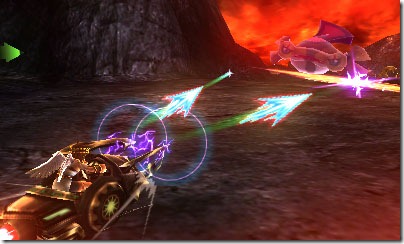
Uprising is fun, but it’s also repetitive. The game is divided into a number of separate “chapters” and almost every chapter in the game is broken up into two parts: an on-rails flying segment where the goddess of light, Palutena, guides Pit’s path as he concentrates on dodging and shooting monsters, and an on-foot mission culminating in a boss fight. The on-foot sections take up most of the game’s play-time, while the flying portions are faster-paced and usually a lot briefer due to Pit only being able to fly for five minutes at a time, lest his wings burn up. The flying sections are huge on spectacle and visual flair and are quite exhilarating and enjoyable. The on-foot missions can get a little tiresome though. I’m not quite sure how to describe it, but sometimes I just wanted some of them to end. I guess lengthy sections where I’m just running around and shooting everything in sight without much exploration beyond a few optional routes yielding a treasure chest reward gets a little dry for me and isn’t quite my thing. Some levels are definitely more engaging than others though, whether it’s due to their visual design or the way the stages progress. One of my favorite stages is an ascension up a tall tower with a unique challenge on each floor (ironically, it’s also one of the longest chapters in the game, and I’ll admit that it does drag on a little too long). And while the formula of flying section followed by on-foot section can get repetitive and predictable, later chapters in the game mix this formula up in ways I won’t spoil, but they’re definitely a welcome change of pace. One chapter in particular really tripped me up, in a good way.

Flying

On-foot

At the end of the day, perhaps this style of game, where the objective is just to shoot or bash row after row of enemies, is just not as engaging for me personally as more adventuresome games. Sure, there are action games like God of War and Devil May Cry 3: Dante’s Awakening that I love and consist of bashing hordes of enemies. But these games simply have more engaging level design, more adventure elements, and more engaging combat. Uprising has nice set-pieces and is a gorgeous-looking game, especially during the flight sections, but the level design of the on-foot sections (which again comprise the majority of the game) is a bit basic and dry, and the combat doesn’t quite live up to the insane action of Devil May Cry 3 or the brutal ferocity of God of War. The combat has some variety, with rapid-fire shots, charged shots, a variety of different weapons and weapon types, and different types of attacks depending on how and where Pit dashes and so on. But you’re still just aiming and blasting away all the time, or if you’re close to an enemy, slashing away. Players also have access to a wide variety of consumable “powers”, a limited number of which can be assigned to Pit before a chapter for use. These powers can be used for everything from damaging enemies, to providing extra defense for Pit, to restoring Pit’s health. These powers have a limited number of uses in-game. 

Ultimately, the fantastic presentation, crazy narrative, and colorful characters kept me engaged and excited for each new level just to see what would happen next. If it was just up to the gameplay, I’d probably have gotten bored halfway through. But that’s me. Other players may find the combat, coupled with the variety of weapons and special powers and unique difficulty system, a lot more engaging than I did. There’s certainly room for some experimentation in the game. I’ll admit, I mainly stuck to a few different weapon types and powers that I liked using and ignored a variety of others that didn’t really appeal to me. These other weapons and powers might have spiced the gameplay up a bit had I experimented with them more.

Uprising feels very polished as a whole. Menus are clear and vibrant and very Super Smash Bros. Brawl-esque (not surprising as the game was directed by Super Smash Bros. creator Masahiro Sakurai). Also like the Super Smash Bros. games, this game is packed with content. I love the wide variety of weapon types and weapons in the game (despite the fact that I ultimately only used a few different weapon types that I felt comfortable with), as well as the weapon fusion system, where two lesser weapons can be combined for a newer, more powerful one. Choosing a unique weapon to take into battle with me before each chapter was a lot of fun. There are also Super Smash Bros.-like trophies (called “idols”) of every character, item, weapon, and location to unlock, tons of achievements to reach for, an online multiplayer mode that I never tried (multiplayer isn’t really my thing), and optional paths as well as unique rewards in levels that reveal themselves to the player only on higher difficulty levels. That brings me to the game’s unique difficulty system.

Menus!

The game employs a difficulty system in which the player can scale the difficulty to their liking, choosing from 0.0 to 9.0 for what amounts to ninety difficulty levels. This type of customization is a great idea, and another surprising feature for a modern Nintendo game, but ultimately I’m not a fan of the way this system is executed. It would be fine if I chose a difficulty, say 6.5, and that difficulty stuck no matter how many times I died in a stage. But how this system works is that the player bets hearts (this game’s currency) to raise the difficulty and when you die, you lose those hearts and the difficulty is also kicked down a full level. So if you chose 6.5, after a single death, the difficulty is kicked down to 5.5. After another death it drops to 4.5 and so on. I hate the way this works. When I play a challenging game, I like to keep working at it until I succeed, and this success comes with a great feeling of accomplishment. When I raise the difficulty level in Uprising, it’s because I want to challenge myself more. But after a single death, no matter how early or late in a level, the game basically tells me that I suck too much and drops the challenge level for me. If I continue to die, the difficulty continues to drop until the game basically poses no threat to me at all and I can sail through a level with little effort. 

Ultimately, this system, which is supposed to allow me to challenge myself, has the opposite effect. It feels like forced hand-holding. It feels like a forced Super Guide (those obnoxious, though optional, things that pop up in many contemporary Nintendo games that offer to complete a level for a player or give a player some kind of uber power-up that helps a player to complete a level). When I continue to die in a challenging game, and the challenge is reasonable, I don’t lower the difficulty setting. I don’t cheat either. I keep trying until I succeed. I simply can’t do this in Uprising because of its difficulty system. If I die against a tough boss, I don’t want the game to basically hand the victory to me, I want to keep trying and persevere over the challenge. I want to improve my skills and get better at the game and overcome its challenges, and that’s not going to happen if every time I die at a tough part, the difficulty drops more and more. And I’m not going to start a whole level over and ramp the difficulty up to where I had it just because I die once. Having so many difficulty levels is great, but I wish they’d stick and not drop if I die. This system might be fine for players who don’t care about the difficulty and just want to breeze through the game, but for me this system ultimately feels like forced hand-holding and makes conquering the game’s challenges less satisfying, especially its bosses.


The bosses in this game are a bit underwhelming. They are huge in spectacle and personality, but most fights just involve strafing around a boss and unloading continuous fire into it. There’s not much strategy involved for most fights and on the lower difficulty levels (which are forced on me if I die a few times), the bosses are total pushovers, and not very satisfying to defeat. There are a few exceptions, but I often had that feeling of “That’s it?” after defeating a boss in this game.

Twinbellows here isn't as tough as he looks

O.k., so there’s a big element of Uprising that I haven’t talked about, and I suppose I’ve broken the rule about putting the most important information first, because this aspect of the game is pretty important. If you read any of the reviews for Uprising back when it came out in March 2012, you’d know that there was one major polarizing aspect of the game: its controls. The controls for Uprising, which were the widely-advertised make or break for the game for a lot of critics at its release, are certainly cumbersome and awkward to get a handle on at first, but they’re far from a game breaker. I own both an original 3DS and a 3DS XL and have tried the game on both and the XL is definitely a lot more comfortable for the game, although the original 3DS just took a little more getting used to and wasn’t too bad (provided you use a different stylus than the original 3DS’s default one, as a stylus that folds in on itself is quite annoying when paired with vigorous play). 

The controls work as follows: players use the L-trigger to shoot, the circle pad to move, and the stylus to aim, control the camera, and select special powers. I tried the plastic stand that came with the game, but didn’t find it optimal due to having to sit at a desk and my desk not being at eye-level and it just overall not being even necessary anyway. I found it was most comfortable to hold the 3DS’s left side with my left hand while keeping my finger and thumb on the L-trigger and circle pad respectively, and support the right side of the system with my palm while I controlled the stylus with my right hand’s fingers. There’s a left-handed option if you use the face buttons (ABXY) to control Pit's movement and the circle pad to aim, or if you buy the not-included Circle Pad Pro peripheral for the 3DS, which adds a second circle pad on the right side of the system and the default controls can be reversed (it should be noted that the Circle Pad Pro is only useful in the game for left-handed players, and there is no option to use two circle pads to control Pit with one and aim with the other).

Yeah, that stand's pretty dumb, but luckily it's not needed


            These controls are a good idea, and they actually work great while Pit is flying in the air, but in practice they can be a bit cumbersome to use while on-foot. Using the stylus to simultaneously aim, spin the camera around, and shuffle through special powers at the bottom of the screen is quite literary a handful, and managing all this with just a stylus can lead to a less than optimal control experience. A typical in-game scenario might require the player to fire at enemies in front of them and then stop firing to quickly spin the camera around to fight enemies that are attacking from behind, while frantically cycling through their list of powers at the bottom of the screen to use their health-restoring skill, all while the enemies continue to attack from multiple angles. The overall positioning of the controls can lead to some hand-cramping as well after extended periods of play. There are other control options to choose from, like using the face buttons to aim (and the D-pad can be used to select special powers), but these other options didn’t seem too appealing to me so I stuck with the default set-up, which I think is probably the best available. Adding the option to use the Circle Pad Pro to control the aiming function with one circle pad and Pit's movement with the other would've been a welcome option, although the accuracy of aiming would be reduced.

Actually, I think this game would control great with a Wii Remote and Nunchuk set-up. Aiming could be controlled with the Wii’s pointer (using either the sensor bar or Wii MotionPlus), firing could be mapped to the Z-trigger on the Nunchuck, and movement to the Nunchuck’s analog stick. Sure, there’d be some other challenges such as how to move the camera, but I think something could be figured out. The game’s high-quality presentation would also suit a console perfectly, so I wouldn’t mind seeing a Wii U installment down the road, or even a port. 

It could work

The vehicles that Pit can ride in the game control a bit slippery (although the Cherubot mech controls solidly), especially the Exo Tank vehicle, which feels like controlling a wet bar of soap. While I’m talking about the gameplay, I feel I should mention that it’s quite annoying that this game features a limited run for Pit. After dashing for a limited time, Pit gets tired and has to catch his breath. A stamina meter works great in some games (like Shadow of the Colossus, where it adds weight and realism to that game’s heavy challenges), but in a high-energy action game like this, it just feels out of place and annoying. I also found the camera angle in the game to be a little awkward in the on-foot sections. It feels a little too zoomed-in, to the point where Pit himself can annoyingly block the player’s view sometimes. 

The Exo Tank

 Kid Icarus: Uprising is ultimately a high-energy and enjoyable experience, combining whimsical sights and sounds and delivering an experience quite unlike anything you’ve seen before. While the gameplay isn’t the most engaging thing in the world for me, it’s still fun, and the entertaining cast of characters and crazy scenarios the game threw at me kept me interested until the end. Perhaps most importantly, the game is a fiercely refreshing change of pace from all the assembly-line Mario games Nintendo has been turning out recently. Featuring a unique and interesting world, entertaining and likeable characters, and a unique new style of play for an old franchise, Kid Icarus: Uprising is one of Nintendo’s most unique and ambitious new games in years. Despite some blemishes in the overall experience, I’d still heartily recommend this game to all 3DS owners.