Showing posts with label experimental games. Show all posts

Saturday, January 16, 2016

That Dragon, Cancer (PC) Review


That Dragon, Cancer
, which I backed on Kickstarter at the end of 2014, is a difficult game to write about. To be more specific, it’s a difficult game to critique. Part autobiographical documentary, part abstract adventure game, but mostly something entirely new, That Dragon, Cancer is the true story of young Joel Green and his four-year fight against cancer (diagnosed at age one), created over the span of several years. As a love letter from Amy and Ryan Green to their son, who passed away in March of 2014 at age five, and a meditation on that terrible dragon known as cancer that corrodes so many lives, it is powerful, beautiful, and devastating. As a piece of interactive art, it’s new and interesting, but flawed. And finally as a piece of programming, it could use some more refining. This is a work that is full of inspiration and made with endless passion. That Dragon, Cancer is a mess of emotions and it’s not an easy thing to digest and appraise. I have issues with it on a technical level in some areas. I have some issues with the way it delivers its “narrative”. But who am I to tell Amy and Ryan Green how they should deliver their tribute to their son? Obviously, That Dragon, Cancer is extremely personal, but it’s also extremely real. So what can I say? I guess I’ll begin by trying to tell you how That Dragon, Cancer made me feel.

It made me feel sad. It kind of wrecked me in some places. It was also an anxious game for me. I think new experiences like TDC are so important for video games as a medium, but I get very anxious when it comes time to play a game like this. I have anxiety and obsessive compulsive disorder, and games where I’m tasked with investing myself in an emotional story, judging an interesting new work of art, and that also involve a lot of looking around and examining details stress me out. All this coupled with what is already a very emotionally trying experience made TDC very difficult to handle for me.

The early moments of That Dragon, Cancer did not do much for me honestly. The game opens in a pleasant and interesting way, from the viewpoint of a duck on a pond eating bread that Joel is throwing on the water. The controls are simple and accessible, mostly relying solely on moving the mouse from side to side and left-clicking when prompted, and this is a game that definitely benefits from being accessible. Shortly after, the camera moves behind Joel and the player is prompted to hand him some bread to throw, but in the process a voice over from Joel’s family plays as well as sound effects, all recorded from an actual day at the park. I’ll say right now that the sound design in That Dragon, Cancer, from the music to the way the voice overs are mixed to other ambient noises, is very strong throughout, and is honestly where most of the emotion comes from, but more on that later. Anyway, since I didn’t want to miss anything, I waited to hand Joel the bread and simply listened to the dialogue…but as soon as the dialogue ended, the screen faded to black and the game moved on to the next scene, without me ever giving any bread to Joel.


This was jarring and distracting to me. There are several times in the game, especially early on, where I felt as though I had missed something, or to be more specific like I had missed out on parts of the story. The game is split into several “scenes” or chapters and sometimes I would inadvertently move on to the next scene or the current scene would suddenly end on me and I’d feel left in the dark. There are few if no comparison points for That Dragon, Cancer in video games, but one game that does come to mind is Gone Home, another narrative-driven adventure game that involves slowly moving through an environment. But Gone Home involved exploring a family’s home in one continuous motion, and the home was designed in such a way—locking off certain areas, subtly guiding the player towards certain things, etc.—that even though it was largely nonlinear I still felt like the story was mostly delivered in a proper way and like I didn’t miss any of it.

By comparison, That Dragon, Cancer doesn’t feel like it has that elegant kind of level design and it also often feels disjointed. It gives small snippets to me of the Greens’ and Joel’s life before snatching them away, sometimes abruptly when I know I’d missed content, and this made it hard to get invested in the emotion or the story sometimes, both because of me feeling like I’d “missed something” and also because the story’s delivery wasn’t exactly clear, and often feels fragmented.

Most of these gripes come from the earlier scenes in the game, however, and there was a point when a shift came and I began to become invested. The first scene that really got to me came maybe a little under halfway through the game. We are taken to a recovery room where Joel’s mom holds him in her arms, and we hear her talking to him about the awful ritual of waiting for him to wake up and about how someday in the future his victory against cancer will just be a distant memory and largely something his parents will cheer, how he’ll tire of hearing about it and have better things to think about and be proud of. Shortly after, we are left to explore the recovery rooms in the hospital. Several colorful greeting cards are littered around Joel’s recovery room. Upon picking one up and reading it, I realized that it was a message from one of the game’s Kickstarter backers commemorating a loved one who had battled cancer. Reading others, I realized they were all memorials of some kind. Thinking there would just be a few to peruse before the story moved on, I read all of the cards in the room and then exited. I stopped in my tracks. A sea of colored rectangles. The cards are everywhere. Hanging from the ceiling. Sitting on chairs, on tables, on the fridge. Dozens and dozens. My first thought was one of anxiety, of knowing because of my OCD and my fear of “missing something” that I’d have to pick up and read each and every one of those cards, and that I was pretty sure this game was going to take a lot longer for me than the advertised two hours. But almost immediately after this thought, I came to the tragic realization that every single one of these cards represented real human lives somehow affected by cancer. The first tears came after looking at just one or two more cards. This entire chapter of the game is nothing but reading about countless people affected by cancer.

This is where I remembered that I wasn’t playing through a fictional story like in Gone Home, that I wasn’t trying to invest myself in fictional characters, that every way I usually tune my brain to think about video games and stories did not apply here. This was all real. These were real people who lost their mothers, fathers, children, and best friends to cancer. Amy and Ryan Green actually went through this. Joel actually went through this. Joel died of cancer. The Greens lost their son.


One particular scene that comes later nearly destroyed me. It involves Ryan sitting by Joel’s hospital cribside one evening as the child begins to ceaselessly begin crying. As Ryan, I walked around the room, trying everything I could to try to stop the crying. The sound of it, to understate it, was heartbreaking. And after remembering that it was real, it became even more devastating. Finally, I (Ryan) managed to caress Joel and calm him down, but not a second later did he begin crying even more ferociously. I (Ryan) tried giving him something to drink and Joel immediately vomited it up. “He won’t stop crying,” I hear Ryan say. “I don’t blame him. He feels miserable.” Then: “I hate that we’re here. I hate that he’s sick. I just want him to feel better” as Joel’s howls tear a hole right through me. It was almost too much. My whole face tightened and quivered in tears. The scene mercifully ended shortly after, but that scene didn’t end there for Ryan. That was just one moment.

That Dragon, Cancer uses a lot of visual metaphors and in addition to the scenes that are grounded in reality, there are also several very abstract ones. Many of these “abstract scenes” left me somewhat bewildered rather than invested though and often took me out of the story. One scene involves encountering Joel undergoing some kind of procedure from an ominous-looking machine, before we are transported to space where Joel begins riding constellation animals, and the whole meaning of it left me dumbfounded. Sometimes these more abstract scenes would be juxtaposed with more grounded scenes of real raw emotion, and the switching back and forth caught me a bit off guard, and again left the experience feeling disjointed for me.

One metaphor that works exceptionally well, however, comes in the form of a more light-hearted and “fun” scene that involves the game surprisingly shifting into a side-scrolling platformer game starring “Joel the Baby Knight”, controlled with the arrow keys and spacebar. Basically, Amy and Ryan’s other three sons can’t sleep one night and so the parents begin to tell them a story, and as their narration unfolds, the adventure is created around the player as Joel. So they say something like “and then Joel went into a forest” and trees fall out of the sky and are laid out before the player. I reached an impassable gap just as the Greens were outlining Joel’s powers, including, conveniently, a super jumping ability that is suddenly unlocked just when I needed it. Quite frankly, it’s brilliant. At the end of the journey, Joel, of course, confronts a massive dragon boss that is a daunting challenge. This whole scene is so simple and effective, and it’s actually sort of ironic to me that this particular section succeeds so well given that it is the one that mimics a stereotypical classic video game (even being initially accessed in-game from an arcade machine).


I guess that latter point stands out to me because I’m not sure what to think of the way That Dragon, Cancer uses interactivity to tell its story. On the one hand, we have powerful scenes like the crying one that are partly so effective because we walk in Ryan’s shoes, the card scene where the player can walk around and read real memorials (and also a later scene where fully voice-acted letters from Kickstarter backers are read that is even more emotionally harrowing), and of course clever parts like the sidescrolling one. But then there are the numerous occasions where I felt that a simple mouse click here and there may have only served to annoy me and get in the way of my investment in the narrative. Sometimes I found the interactions cumbersome and unclear (I fumbled a bit trying to figure out how to push Joel on a swing, for example). I feel both simultaneously that TDC could have used more interactivity and that perhaps it could have benefited from less. The thing is, TDC is so barely interactive oftentimes that it feels like perhaps it should have had a lot more interaction or at least used it to tell the story more or perhaps it should have just taken it out altogether and just have been a game that involved moving around spaces and listening. In fact, a lot of times I found myself just sitting and listening, and sometimes didn’t even have my hand on the mouse.

No, this is not a critique on the storytelling capabilities of the interactive medium as a whole (nor is it a condemnation of unconventional “not-games”) and I still think there is enormous potential in this department. This is more an indictment of the way TDC does things than of the medium as a whole (there are many other interactive experiences already where the interactivity wholly benefits the narrative or reinvents the way a story is told and there is so much future potential in this area). I also don’t think That Dragon, Cancer would have necessarily been better suited to film, citing the previous handful of scenes I mentioned as strong counterarguments to that notion. Also, having me saturate myself in the Greens’ and Joel’s experience, linger there and inevitably feel some of their pain, is what makes this experience what it is. At the same time, like I mentioned way earlier, most of the emotion does admittedly come from the voiced sound clips rather than what’s actually happening on screen or what the player is doing. Perhaps the game’s simplistic, polygonal visual style also may hurt it somewhat as well, as it was hard for me to get invested in a blank-faced Joel, and sometimes these empty-faced characters came across as eerie. While That Dragon, Cancer is unquestionably an interesting game and while it is something I believe to be positive for video games as a medium, I just question how well it actually uses the interactive medium to deliver its experience. Perhaps this is just me trying to wrap my brain around something entirely novel though, because although comparisons can be made, there really is nothing else quite like TDC in video games or any other medium (that I’m aware of, at least).

Basically That Dragon, Cancer is a back and forth experience for me. Some scenes are powerful and raw and punching, while others fell a bit flat for me. The penultimate scene of the game was another that left me a bit lost. I found it clever at the start and it is also one of a few scenes where the game’s simplistic art does shine, but I eventually ended up being confused as to how to advance the scene, which took me out of the experience, and also what the whole thing was trying to represent exactly. The very final scene that followed, however, struck an appropriate chord, and the credits brought more tears streaming down my face.


It feels tacky to nitpick about technical shortcomings in an experience like this, and I probably wouldn’t do so if not for the fact that one instance had a large impact on my experience. It’s hard to explain this, but certain scenes just feel odd…almost like they are missing something or incomplete somehow, and in sections that do require a bit more movement than usual, the control is very stiff and awkward. This all lends the game a clunky feel at times, but most notable of all and the reason I even bring any of this up is the very unfortunate glitch I encountered where the game locked up on me. For those that have played the game (and a warning to those that haven’t), shortly after the “Drowning” chapter started, I backtracked a bit (while in control of the bird) because it seemed like I may have passed by a certain section of the level. Apparently the game didn’t count on the player backtracking at this part and it seemed to “softlock” at this point; I could look around and the music was still playing, but the prompts that normally appear that let the player move around would not appear anymore. I tried everything, but I was completely stuck. This obviously shattered my immersion and at a point late in the game when I was extremely invested. I was crestfallen at first at the thought of starting the whole game over (there’s no saving and it’s obviously meant to all be played in one sitting), but upon going into the pause menu, I remembered that I could select chapters individually. Luckily, I had just started a chapter so I didn’t lose any progress, but it still momentarily took me out of the experience in a large way, which is a huge shame in an experience like this.

Despite my mixed feelings on the many different facets of That Dragon, Cancer’s design and my criticism of its technical shortcomings, it absolutely left an impact. When I simply reflect on the experience overall, the way it made me feel, what it made me think, how it impacted my life, it left a scar. It had an impact. This is an experience that had me in streaming tears not once, but multiple times throughout it. I get watery-eyed a lot during games, movies, songs, whatever, but I can’t remember the last time any piece of media had tears spilling down my face like this. It made me feel depressed after finishing it, but it also makes me reflect on how much human beings can love one another. It makes me reflect on how devastating cancer is and how it has impacted my own life and the lives of my loved ones. It makes me appreciate my life more. I have several physical health issues that, while not serious, negatively impact the quality of my life in several ways, but That Dragon, Cancer threw in my face just how fortunate I actually am. It made me appreciate my life and my physical health and made me vow (or at least make a serious, focused effort) to stop complaining to myself so much about my own comparatively very minor physical health problems. It makes me appreciate my loved ones more and their physical health. It’s a disjointed experience, but an affecting one, and one full of love, and despair, and passion, and humanity. That Dragon, Cancer is full of humanity and it made me feel connected to humanity, to other people, in a way that no other piece of media perhaps ever has.


Tuesday, December 1, 2015

Gone Home (Spoilers)


Gone Home is a strangely personal experience. Maybe it’s the nostalgic sense of place: an American family’s home in the mid-90s, which was the golden age of my childhood. A palace full of VHS tapes, music tapes, Nintendo tapes, and gaudy colorful school folders and highlighters. There are references to Harrison Ford, Street Fighter, and those little black label message thingies. Or maybe it’s the way the main character, Sam (not to be confused with the player character, Katie) reminds me of myself. No, I’m not a teenage girl, but I was once a shy kid in high school, who frequently imagined my own characters and stories and who still has old doodles and school assignments scattered around. I also had a high school teacher who encouraged my creative writing and I ended up going to college for it. Maybe it’s other small details: the reference to one of my favorite films, Pulp Fiction, or spotting a host of books I studied in school and have fond memories of in Sam’s bedroom (Frankenstein, Treasure Island, Jane Austen’s Emma…), or that Janice Greenbriar has the same birthdate as my own mother…or perhaps Gone Home would have just felt personal anyway, even without all this, because it’s just an intimate experience by nature. When I first walked into the empty foyer of the Greenbriar home, it was just another location in a video game, but by the time I approached Sam’s journal in the attic, after opening drawers, reading letters, listening to music, picking up crumpled manuscripts, finding secret notes under the bed, looking at newspaper clippings, looking at photos, and otherwise immersing myself in a lived-in, inhabited space, I felt like I knew the Greenbriars intimately and they felt like a family as real as my own. Like Sam could have been someone I went to high school with and I just never knew about everything she was going through.

It’s this sense of discovering a family, of discovering people, via the traces of themselves and their experiences that adorn their home that makes Gone Home special. Not just learning about Sam’s experiences and her relationship with Lonnie, which is the crux of the narrative, but learning about the marital problems of her parents, the affair her mother almost had, and her father’s struggles as an author of a series of bizarre JFK time travel novels. These people feel real, and I feel like I know them personally even though I never actually met any of them face to face in the game. Especially Sam, whose characterization felt so tangible (and the music that accompanies her diary is so perfectly matched) that I couldn’t help but tear up every time she sighed or expressed her frustrations and dreams.


Ironically, the only member of the Greenbriar family I learned next to nothing about is Katie, the one who I literally stepped into the shoes of. I learn she traveled around Europe and she occasionally has some reaction text to certain objects in the house (“Gosh, Sam” she says when discovering her sister’s issue of “Gentleman” magazine, the magazine for men, and “Oh, barf” when finding a condom in her parent’s bedroom dresser), but the only personality trait I really glean from her is that she is the “straightedge” Greenbriar child: the athlete, the scholar, the “responsible” one. In other words, pretty boring. One of the funniest moments in the game comes from discovering a Sex Ed assignment in one of Sam’s school folders in which she took a hilarious amount of creative liberty with a rather simple assignment (“See Me!” was the grade she got from her teacher in bright red letters). Then later on I discovered Katie’s own take on the same assignment, which of course was done perfectly and properly and got a bright red “check plus”. But I suppose it’s unfair to call Katie boring, because I’m sure that if I had the opportunity to rummage through her own stuff (still packed away in boxes in the guest room of the Greenbriar’s new home, which was to be her room when got back from Europe), I would find a three-dimensional person with her own struggles and experiences. Gone Home makes it clear that it’s not about Katie though, but rather her family and principally her younger sister, Sam.

Sam is one of the most richly drawn people I’ve seen in a video game (or, sorry, I guess I should say in an “interactive exploration finding and reading stuff emotion story simulation experience”). I hesitate to call her a “character” because she seems so real and authentic. Her voice actress does an excellent job but Sam’s personality also shines through in the pieces of herself she’s left lying around her house: in the scattered chapters in the ongoing tale of Captain Allegra and her First Mate, in her Street Fighter cheat codes lying on her bedroom floor (repeatedly crossed-out and revised), in her angry note to her parents chastising them for not letting her go out with Lonnie in the city, in her aforementioned unique take on schoolwork and the various scraps and doodles and letters that all in all paint a very vivid portrait of a human being. Gone Home does a wonderful job of setting up a series of mini-narratives that get told through pieces of the Greenbriar’s life around their home (would Danny ever get his Nintendo tape back??) and I enjoyed following all of these, but of course the narrative I was most invested in was that of Sam and Lonnie. This is where Gone Home is also just a sweet story of young romance, one that treats Sam’s homosexuality not like a twist or a discovery, but rather a given, natural fact of her life, while still managing to address the very real issues of what it means to be a gay teenager in high school (especially in the mid-90s). This is a story that moves, but also aims to inspire empathy for a life experience that some might regard as foreign and strange. A story that might make some people realize that a gay relationship is in fact not these things, but just as relatable and human as any other romance.


That is the key word: Gone Home struck me in how human it felt. It shines a lens on one family’s, and one girl’s, personal struggles, it promotes empathy for our neighbors, for our friends, for complete strangers, for those we might regard as pariahs; it reminds us that we are all human and that we all go through shit. Speaking more personally, it allowed me, a straight man, to empathize with a gay young woman and the pain of dealing with disrespectful parents and peers; the fact that I have so much in common with Sam made it all the more easy to relate to her. I can relate to being shy around people I like (seeing that “gold star” around someone but not knowing how to talk to them), and so much of what Sam experiences and says and writes and does reminds me of myself and my own experiences, I can’t help but easily put myself in her shoes. Perhaps it is because of all this that I really did not want to enter the attic at the end of game. I felt a connection with Sam and I wanted her story to have a happy ending, but the more the game went on, the more I got the idea that the diary that I’d been hearing throughout the experience was Sam’s last words, and I was afraid of what I’d find up there. When all I found was an empty sleeping bag accompanied by a final, joyful diary entry from Sam about how Lonnie decided she couldn’t live without her and the two ran off together, I was ecstatic. A surprise happy ending, a joyful outcome when I expected a grim one, is one of my favorite discoveries in fiction, and Gone Home’s conclusion left me in happy tears.

Gone Home is the kind of experience I’ve been wanting to play for a long time. It’s simple and really nothing extraordinary, but that’s exactly what makes it special for a video game in a medium where interactive experiences so often feel the need to couple extraordinary circumstances with their pathos. In Gone Home, there are no monsters (or more specifically, no ghosts), no combat, no big dire mystery or circumstance. Why is the Greenbriar home mysteriously empty and seemingly abandoned and what happened to Sam? The big, dark, earth-shattering answer: Mrs. and Mr. Greenbriar are off at couples counseling and Sam ran off with the love of her life. I’ve played a lot of games before where much of what I do is walk around and read stuff that fleshes out a world or a narrative, but I respect Gone Home’s restraint in not shoehorning unnecessary violence or fantasy elements into its plot, and still managing to keep me interested in its characters and story through compelling writing, voice acting, and world building. This is just a patient, grounded, human experience and I appreciate it for that. There is still much room for growth when it comes to interactive narrative, and Gone Home is only one of many unique ways in which the interactive medium can deliver an interesting experience, but for now I wouldn’t mind seeing more games like Gone Home. Relaxed experiences where a character simply walks around, talks to people, look at objects, perhaps finds clues and solves a mystery…or maybe just talks to a friend, buys a hot dog, watches a sunset…stuff besides slaying monsters, going on adventures, and saving the world, stuff that doesn’t need violence or combat or even esoteric puzzle solving (as compelling, and often emotional in their own right, as those experiences can be). Of course, this kind of experience can still involve an intriguing mystery or something fantastical, but the point is that a video game can still be something compelling without shoving ten hours of gunplay in-between low-key narrative exploration sections (leers slowly in the direction of BioShock Infinite). I don’t blame someone for criticizing Gone Home’s narrative as being too small, but I think that the game is quite revolutionary for being a video game that is just about exploring a family’s home and learning about their lives. I also think it’s just wonderful that something like Gone Home and something like Shovel Knight can both exist in the same medium, or at least under the hazy umbrella term of “interactive experiences”, and I think this is a testament to the power, potential, and overall amazingness of this medium.


Sunday, September 21, 2014

Flower (PS3) Review


Flower is a beautiful little game. It’s…look, I’m going to be honest with you, I haven’t been having the best day. I found myself not wanting to get out of bed today; found myself wondering, as I sometimes do, why I ever get out of bed. It was safe in there, warm; why leave? Why not just retreat back to the land of dreams? Why get up? Why leave such a safe haven and deal with all the stress, fear, anxiety and discomfort that waking consciousness would bring me? I shut off my alarm and tried to just relax. Just forget. I finally did get out of bed and was disappointed in myself. It was already far too late to squeeze in everything I wanted to do today and therefore I didn’t feel up to doing anything at all. As evening came on, physical discomfort joined my emotional discomfort and even though I still had a headache among other aches, I say down to play Flower. In the PS3 menu before even starting the game, a simple image of a blue sky and tall green grass with a single flower in the corner was accompanied by a tranquil musical piece and a simple, three line tutorial on how to play the game, explaining the only two actions needed (“tilt the controller to soar” and “press any button to blow wind”) followed by the words “relax, enjoy”.

Relax, enjoy.


These words…. Maybe such a thing is simple for most people in their down time, but it is very difficult for me to “relax” and “enjoy”, at least completely. But these words still brought comfort. Encouragement. They were quite simply, what I really needed to hear at that specific moment in time.

 
The opening moments of Flower juxtapose a noisy cityscape with a peaceful green field in the middle of nowhere. This perfectly reflected my current feelings. All the stress and frustration and noise then…peace. Just what I was looking for. The opening moments of playing Flower were exhilarating. As the text earlier informed me, pressing and holding any button summoned a gust of wind that moved a flower petal, while tilting the controller itself aimed it. That was it. I was just a flower petal, weightless and free, soaring over a field of tall green grass blowing in the swift breeze. A blue sky and golden sun were overhead. I felt a breath of fresh air.  For a moment, I didn’t feel shitty or anxious or sad. I felt gleeful.

And that’s really it. Flower is that moment. Sure, the game goes through a few different settings and changes things up with each level (or “flower”) you play; it’s a journey that leads the player through tranquil valleys, over windmill-covered plains into the sunset, across a dreamlike nightscape dotted with streetlights, into a dark and lifeless wasteland and finally to the city itself, all in a quest to restore life and nature and deliver the simple message that something as simple as a flower petal can bring so much joy and meaning to life if you just take the time to notice it.


Maybe this all sounds hokey to you. Too pretentious, overly sentimental, or too obvious a metaphor. But it’s effective, damnit. It’s human. And is it so obvious? How many of us don’t take the time to appreciate a flower blooming in the middle of a city? And I mean really appreciate it. How much better would all of our lives be if we just remembered, every day, every moment, how much happiness little things can bring? Not just flowers but a warm blanket, a conversation with a dear friend, a cool breeze, a really creative video game.

But at its core, Flower is really all about that opening moment of blissful play. That feeling of weightlessness. Of mirthful flight and wonder, a vast landcape with a blue sky above. What a goddamn ingenious concept for a video game: a flower petal floating in the breeze. Maybe this is something you’ve seen in hundreds of art films and read a thousand poems about, but how often do video games tackle this kind of subject? And how perfect are video games for this kind of experience? What other medium uses a combination of sight, sound, and feel to allow us to assume the role of a flower petal dancing in the wind?


Flower isn’t a perfect experience. It’s at its best when it actually makes the player feel like a weightless object gently gliding through the open air. Its central objective of guiding your slowly growing swarm of flower petals into rows of flowers on the ground in order to make them bloom, gather more petals, and magically cause certain environmental reactions can sometimes conflict with the core experience that the game is trying to deliver. It can be tedious if you miss one or two or six little flowers which blend in with the ground and have to awkwardly spin around looking for them. This act can take away from the gracefulness of the whole thing and remind me that I’m playing a video game, looking for objects.

But whatever. The game doesn’t require every little flower be touched, that was mostly just my OCD’s idea, always terrified of “missing something”. This is a game about being a flower petal and joining other flower petals and floating in the breeze. And I got to do that. Flower isn’t life-changing, but it is life-affirming in its own small, but oh so important way. It’s not revolutionary, but it actually kind of is. It gives me so much hope for the potential of video games. Video games…interactive experiences can be about anything. Anything. In an industry and medium that is driving itself into the ground with shallow narrow-mindedness and stubborn, strict definitions of what a “video game” should be and is, Flower might as well be a revelation. And I know there have been plenty of indie games tackling original and experimental ideas since Flower originally released five years ago, but in regards to mainstream video game culture, I still think the previous statement in valid.

More importantly than that, Flower, in its simple way, reminded me on a shit day of how life can beautiful and about what makes me happy in life.

It answered my questions from earlier: it reminded me why I get out of bed, at least for today.

Sunday, September 1, 2013

Seven Video Games that Redefine "Video Game"


I played seven video games over the weekend. Most of them weren't fun (at least in the traditional sense). Most of them actually downright depressed me. When it comes to the "video games as art" debate, I've heard that the medium might be onto something when a game makes a player feel depressed.

Well, thanks to a handful of flash games, none of which lasted more than a few minutes, had any more than two basic actions, and featured bare-bones, minimalistic visuals, consider that feat accomplished.

These seven games probably won't change your life, and you might just walk away confused, but I guarantee that you'll at least think: "Well, that was interesting." All of these challenge the notion of what video games are expected to be, and use the medium's most important and unique tool, interactivity, to try to make the player feel something.

And even though some of these games left me scratching my head, all of them made me stop for a moment after I'd finished playing and meditate for a moment on what I'd just experienced.

Every Day the Same Dream


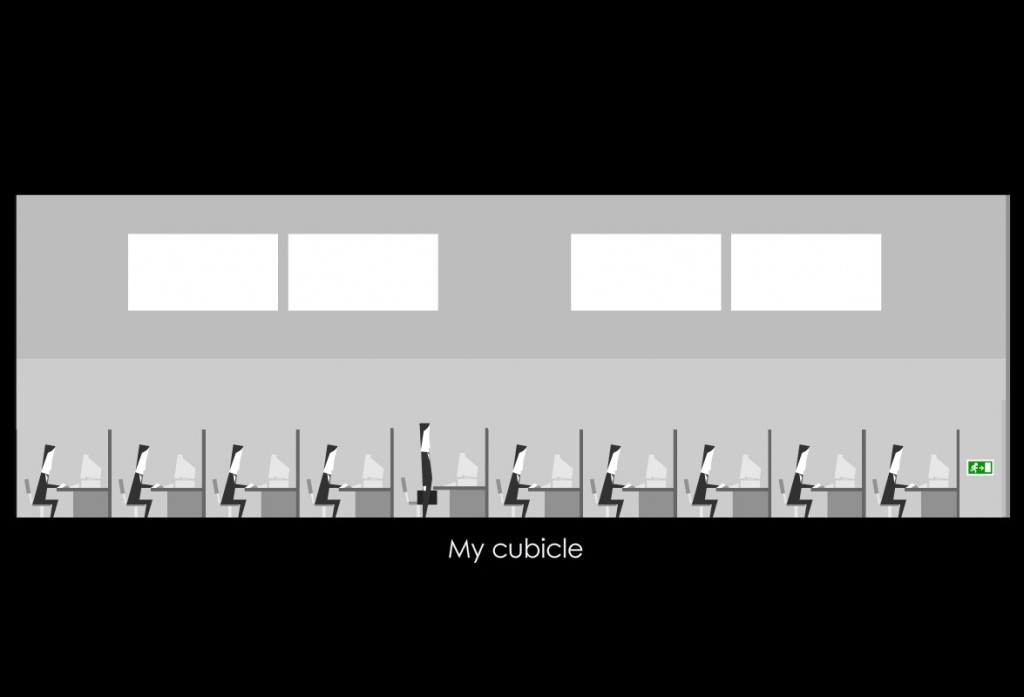
Featuring a bleak art-style and a single droning guitar melody that plays throughout the game's entirely, Every Day the Same Dream follows one man as he wakes up, gets dressed, exchanges pleasantries with his wife, gets in his car, drives to work, gets berated by his boss, and sits in his cubicle. Over and over and over again. It is entirely possible for the game to become an endless loop, but there is a end-point that the player can reach if they are enterprising enough. This game uses repetition and blandness to highlight the importance of stopping and doing something completely different every once in a while. I'm not exactly sure how to interpret the cryptic ending, but it still gave me chills.

The Company of Myself


This game uses its gameplay mechanics as an allegory to tell the story of a hermit. The main character tells us that he used to rely on the company of others, but now he only has the company of himself. He has gotten good at "multitasking" and solving problems on his own, and this is symbolically shown through the game's unique central mechanic of creating multiple "replays" of your character that you can then use to solve puzzles and make it through the game's many obstacles. The game can get a bit tedious and at some points I just wanted to give up, but the pay-off is worth it in the end. The game has a distinctive atmosphere and left me feeling lonely and sad.

I Wish I Were the Moon


Can this be called a video game? How do you define "video game"? Is it any digital work that is interactive? I Wish I Were the Moon consists of a single screen with a few distinct elements: a girl rowing a boat, a boy sitting on the moon, a passing seagull, some stars...by moving the mouse, the player can take photographs of these elements and magically move them to a different place on the screen. For example, the boy can be removed from the moon and replaced with the girl for interesting results. By mixing and matching these elements, five different endings can be viewed. A somewhat cute experience, this "game" that is more like an interactive painting is certainly interesting.

One Chance


"In six days, every single living cell on Planet Earth will be dead.

You have on chance."

These haunting words open One Chance, a game about making decisions and living with them. Scientist John Pilgrim and his team have found a cure for cancer, but in a horrifying twist, this discovery has lead to the release of a deadly pathogen that will kill every living thing on Earth in just six days. You, as John, must make the tough decisions: spend the final days with your wife and daughter, work tirelessly in your lab trying to find a cure, or throw away all responsibility and abscond with a female co-worker. The way things dramatically escalate in the extremely short time frame of this game creates a desperate and chilling atmosphere. What started out as a goofy-looking game that reminded me of South Park art-wise for some reason had me feverishly debating whether to spend my final days in the park with my daughter or drag her to my lab and try to cling to hope for a cure with everything I had. And just like the title says, you really only have one chance. No matter if I tried replaying the game, refreshing the page, or reopening my browser, I could not try again. I'm sure you could find a way to circumvent the rules to try the game again and make different decisions, but that defeats the point. My only issue with this game was that my final outcome was a bit ambiguous. This ambiguity left me wondering if I'd made the right choice or not. But maybe this dissatisfaction was purposeful.

Today I Die


Another game by Daniel Benmergui, the experimental designer who created I Wish I Were the Moon, Today I Die also challenges the definition what a video game is. To put it simply, Today I Die is an interactive poem where you switch certain words of the poem around to change the environment and situation. I think it's a game about helping a girl rise out of despair or deep depression. It can be equal parts baffling and uplifting and it only take a couple of minutes to experience.

The End of Us


The End of Us is one of the most interesting concepts to me out of all of these games, but it falls a bit short of its full potential. The mission of the game is to evoke feelings of friendship and attachment purely through gameplay. What's more interesting is how it attempts to do this using two comets, as opposed to something more human-like, as the participants. I love the idea of evoking specific emotions purely through game mechanics and it's a concept that is sorely underused in the mainstream gaming scene, which often relies too much on the language of film (cut-scenes and grand set-pieces, etc.) to evoke emotion and tell its stories instead of taking more advantage of what makes video games so unique: their interactivity. Sure enough, flying around with and bumping into my orange buddy as we both travelled through space did evoke some feelings of affinity within me. But the experience was far too brief, lasting the duration of a single short song that accompanied it, for me to get truly attached to my comet friend. The game also ended a bit confusingly instead of having the emotional impact that I think the designers were going for. The description for the game talks about a final, important "choice" near the end, but this choice was never apparent to me. Also, the ending sequence takes control away from the player, which I think also diminishes the impact. Great concept and a fair effort, but unfortunately it wasn't as meaningful as it could have been for me.

Freedom Bridge


The last game I played was perhaps both the most effective and the most minimalistic. Featuring nothing but a black square in a white space interrupted only by a few black squiggly lines, this game tasks the player with guiding this square to the right and nothing else. But the way the "black square" started to trail blood after passing through the "squiggly lines" and the sound of rushing water that got louder and louder as I moved on created a sour feeling in the pit of my stomach. Freedom Bridge only took a minute, maybe three at the most, to "play", but it affected me. It left me depressed and confused and capped off a day of playing bizarre and mostly depressing video games.

...

Are they video games? Really, it doesn't matter. One day the label "video game" might morph into something else or maybe "video games" will be separated into sub-categories. Again, it doesn't matter. The point is that these seven experiences left me staggered by the artistic potential of this medium.

If these games, which lasted mere minutes and featured barely any frames of animation and only a few screens, could leave me feeling anything, none the less inspire attachment to soundless, pixelated little characters, or empathy for a moving black square, just imagine what video games, what interactive experiences, could accomplish with big budgets and teams of talented designers and artists pouring their vision into them.

Again, the pure potential of this medium as truly inspiring and unique art unlike anything else we've ever seen is staggering.

There will always be a place for video games that celebrate pure joy like Super Mario Galaxy, for games that revel in more base and primal pleasures like God of War, for games that weave brain-bending puzzles and witty narrative like Portal, games that send us on epic adventures and invite us to explore new worlds, and games that just make us laugh and smile. Games can also of course be both fun and emotionally affecting or meaningful. Fun is not always divorced from meaning. But there is also a place for video games that make us sad, or that make us introspective, or that comment on our lives and our reality in deeply meaningful ways. Games that inspire in us some deeper meaning than just pure mental satisfaction, or just simple fun, and also games that don't feature any kind of combat, violence, or any of the other traditional trappings of the medium.

When interactive experiences can be about anything, it is downright criminal if we limit this medium to only delivering big-budget games that, at their core, are about combat or violence in some way, or are set up as fantasy, wish-fulfillment adventures. These widely-prevalent games are superb fun, but there is room for so much more. Titles like Dear Esther and Gone Home show some of the potential of what an artist can do with an interactive space beyond just combat and fantasy. And with the advent of iPhone games, crowd-funding, and Steam, more and more bold new ideas are being explored. I'm not saying that violent or fantastical games can't be powerful and meaningful. You need only look at many of my old favorites like Silent Hill 2, Shadow of the Colossus, and The Legend of Zelda: Majora's Mask, all games that employ violence and fantasy in their deliverance of a deep and meaningful experience, for proof of that. I'm also not saying that all games should be "artsy" and abstract. And even though many of the above games left me feeling depressed (and the combination of them all left me yearning for something happy and colorful by the end of the day), I'm not suggesting that video games should start depressing people more at a much more profound rate. I'm just saying that video games do have the power to depress you, and they also have the power to enrapture you, to enlighten you, and to fill you up with emotions you never even knew you could experience. I'm saying that video games can explore so many more topics than they are now, and deliver an almost limitless range of experiences.

This limitless potential has only been barely breached. I find myself immensely excited and proud to be a supporter of this beautiful medium, which is on the verge of expanding into the world's next great art form.

I only hope that my fellows, those who love video games, can embrace the enormous potential that our favorite pastime has, even if they don't care about games like Gone Home and just want to kill things with a samurai sword.


Special thanks to Extra Credits for recommending these games.

Also check out Anthony Burch's "Fun Isn't Enough".

Also, this Extra Credits episode. Also, all Extra Credits episodes for wonderful insight and intelligent lectures from people who love video games just as much as I do. Maybe even more. And that's saying something.