Showing posts with label sora. Show all posts

Saturday, January 31, 2015

Super Smash Bros. for Wii U (Wii U…duh) Review


This review is going to a bit more informal than usual; originally I wasn’t even going to call this a review, but more just a “thoughts and impressions” kind of thing. I’m not going to explain or cover everything in Super Smash Bros. for Wii U in detail and am going to assume the reader (i.e. you) already has some knowledge of the game and the game’s content in this case. Above all else, this is mainly just about the aspects of the game that particularly stood out to me. With that out of the way, here are my thoughts on the newest Smash experience.

My experience with Super Smash Bros. dates back to the original game on Nintendo 64, which I fondly remember playing after school when it first released and also with friends many other times. It was such a surprising and novel game back then, and even though at the time I had never played a Metroid game and certainly had no idea who the hell Captain Falcon was, I had a blast nonetheless playing as Kirby and Samus Aran, unlocking everything, and doing all those “Break the Targets” and “Board the Platforms” levels. Later on Super Smash Bros. Melee cranked the series up to 11 and established the mold that the franchise would take the form of from then on. Super Smash Bros. Brawl built on what Melee established, not quite being another huge leap forward, but simply cramming more into what Melee had while also adding several new elements. Now, with Super Smash Bros. for Wii U, it’s pretty much that same game again, except stuffed with more characters, more stages, more music, new modes and uber-polished gameplay that merges Brawl’s casual party game approach with Melee’s more technical skill-based approach. The result is…well, Super Smash Bros., now with the Duck Hunt Dog and Mega Man. That is to say, it’s one part polished, unorthodox fighting game crammed with stuff that is best enjoyed with friends and one part Nintendo museum. I think for me at least, however, the novelty of this series has worn off. I was excited about the game when gameplay was first shown off and loved every second of those character reveal trailers and all the speculation that went along with the game’s pre-release hype, but as the game’s launch got closer and closer, I found myself a bit apathetic. I was going to pick it up day one, but wasn’t necessarily overly excited for it and honestly sort of got sick of hearing about it after a while. Personally, I get much more excited for a new Metroid or Zelda game than for a big crossover that aims to make me nostalgic for those experiences. There’s just not much mystery when it comes to Smash anymore, especially thanks to the wonder (and the bane) that is the leaky internet. But I digress. While Smash Wii U has certainly had less of an impact on me than any of its predecessors, it’s still certainly a well-made game with a lot that I admire about it and a lot that I am fond of (and not so fond of) within it.

Multiplayer is still one of the most important aspects of Smash Bros. and thanks to the inclusion of up to eight-player battles, the game is now more a party pleaser than ever before. Online works better than in Brawl (honestly, this is mainly going by the word on the street since I barely used Brawl’s online, but I’m aware that most unanimously agree that it was shit), but unfortunately every single mode barring For Glory 1v1 was met with varying degrees of lag when I tried it all out, some of it hilariously unplayable and some of it manageable but still far from ideal. Unfortunately, if just one person has a bad connection, it ruins it for everyone. Luckily, 1v1 works mostly great and I’ve been able to get in a hundred matches here, mostly getting my ass kicked, but also winning a passable amount and having some fun encounters with strangers I will likely never encounter again. Although I should mention that, weirdly, my most recent 1v1 session was met with lag in almost every match I played; I don’t think this was on my end since I have a wired connection, but it’d also be a weird coincidence. But luckily and most importantly, online with friends in my experience works flawlessly as of this writing. I play with two friends and we all have good connections and I can recall maybe one instance of brief stuttering but otherwise every match has run as smoothly as if we were in the same room (it should be noted that every match we’ve played has been a stock battle with all items turned off). It’s great to be able to jump into a match with friends and not have to always gather together (because who wants to see their friend’s stupid faces, amiright? I kid, I kid).

Chaos!
As for everything else in Smash U…sigh…ok, I’m not going to go over it all in detail, but mainly just point out the stuff I notably like and dislike, because there’s a lot of stuff here. First off, and this should go without saying, the character roster is massive and it is spectacular. Besides being able to have a sparring match between Mario, Sonic, Mega Man and PAC-MAN, all the newcomers are excellent additions to the roster and each is as unique as the last. Villager and Wii Fit Trainer are hilarious and creative inclusions, and others like Little Mac, Bowser Jr.+ the Koopalings, Palutena, and Rosalina and Luma are all great additions that make sense. Having a little known character like Shulk will hopefully increase exposure to the hard-to-find Wii gem Xenoblade Chronicles (which is getting a port to the New 3DS later this year, although I’d still recommend playing that game on a big screen, which suits the game’s epic scope more) and Duck Hunt is the craziest, funnest surprise character the series has seen yet. As for the stages, I generally like all the new ones, which are vibrant, detailed and meticulously crafted fighting arenas. There do seem to be too many overly gimmicky stages, however, and an option to simply turn off hazards like the Yellow Devil of Mega Man fame on the Wily Castle stage would have been ideal (the option to choose a flat final destination variant of each stage is a nice, if imperfect, compromise though). Disappointingly, there are less brand new stages here than in Brawl and more returning stages than ever before. I wouldn’t have as much of a problem with this (it’s not only about always having more) if it weren’t for my other problems with the stage selection. This is my personal taste, but some of the choices for returning stages here are…eh. I would have gladly seen creative and memorable stages like the Wind Waker Pirate Ship from Brawl (which would have made perfect sense, since The Wind Waker HD just came out on Wii U a little over a year ago) return instead of the bland Mario Circuit stage from Brawl (which feels out of place next to its shiny new replacement one from Mario Kart 8), two nearly identical Animal Crossing stages, and that Kid Icarus level from Brawl that nobody likes. There’s more stages than ever before, but the selection feels smaller than in Brawl somehow, thanks to the prevalence of returning stages but also because there’s a lot of “sameiness” in the stage selection (two Skyworld stages, two Animal Crossing ones with a near-identical aesthetic, two Mario Kart ones, two lava Metroid stages, two Wuhu Island-based ones, etc.). However, I do love the variety that stages such as Gaur Plain from Xenoblade Chronicles and the Duck Hunt arena add to the selection. Ultimately, I feel that Super Smash Bros. for Nintendo 3DS is a culprit here, as I would have loved to have gotten some of that version’s new stages in HD and also some of its returning ones.

I haven’t mentioned it yet, but I passed on the 3DS version and wish it never existed (I did spend a good chunk of time with the 3DS version’s demo though). All it seems to have done is rob the Wii U version of content and I hate having this newest Smash’s content split between two versions. It makes Smash Wii U feel less comprehensive due to its general lack of Nintendo’s handheld history, and I like Nintendo’s handheld history, I like it a lot in fact…but I don’t want to have to buy a watered-down version with an inferior control system to celebrate it. This is a selfish choice and I recognize that many who don’t own a Wii U appreciate the handheld version and I can understand its portability appeal, but for me personally, I’d rather Smash Bros. stay as a single home console release.

Characters!

The next main point for me to hit on is the game’s soundtrack, which is a massive 400+ plus songs, with a great number returning from previous Smash titles, but also with a wealth of new remixes, new original songs, and “new” unremixed songs that weren’t in past Smash games as well. Similar to stages, there seems to be less new music remixes here than there were in Brawl, but with nearly 150 new remixes and plenty of other great music it’s harder to complain here than with the stage selection. Still, it does seem like a lot of content in this game has been reused from past titles, which makes this newest Smash Bros. inherently feel a little less new than past titles, and less like its own game and more like a huge expansion on what came before. That said, I love the overall comprehensive nature of the soundtrack and have had a blast just listening to the in-game sound test and editing my music favorites list and fiddling with the My Music feature, which lets players set how often songs play on every stage (all of which is very, very appreciated). Several of the new remixes rock: some of my favorites include the Legend of Zelda: Ocarina of Time “Gerudo Valley” remix and Spirit Tracks “Full Steam Ahead” remix, the “Duck Hunt Medley”, every single Mega Man remix, and just about everything Yoko Shimomura, Yasunori Mitsuda, and Yuzo Koshiro worked on. Other remixes are not so much my cup of sleepytime herbal tea with a touch of milk and sugar. I admire artists being creative here but I think a bit too many liberties were taken with some songs, and in some cases wish the original track was included instead (luckily, in many cases both a remix and the original track are included, which I appreciate). Truth be told, even if I can appreciate a good remix, I almost always prefer original songs to their remixes and this couldn’t be more true in cases such as the “Try, Try Again” remix from Mario and Luigi: Dream Team, which isn’t necessarily bad, just much inferior to the original in my opinion (Shimomura’s only blemish here, and for my money probably ever, so we’ll let it slide). When it comes to song selection in an individual series, there seems to be a lack of variety in many cases, with an overwhelming focus on endlessly remixing the most iconic themes from each game. It makes sense to remix the most recognizable theme from a series for Smash Bros., but as someone who is very intimate with the likes of Zelda and Kirby, it pains me to know of all the other fantastic tracks that are being ignored in favor of yet another Legend of Zelda “Main Theme” cover or “Green Greens” remix (as good as these remixes often are). But nowhere is this more apparent or annoying than in the tiring seven remixes of the freakin’ Donkey Kong Country “Jungle Hijinx” theme that’s we’ve all heard one zillion trillion times before. This wouldn’t be so offensive to me if these three hundred versions of the same damn song didn’t take the place of the countless other possible inclusions or remixes from the varied and fantastic soundtracks of the Donkey Kong Country games (sure, we get a couple of other songs, but most are just taken from Brawl and even then there are not a lot). Three of these “Hijinx” remixes are from past Smash games, so those can be excused, but the other four being included at the expense of something new cannot be. Most face-palm worthy for me personally is the fact that two songs were chosen from the sublime masterpiece that is the Donkey Kong Country: Tropical Freeze soundtrack and one of them is the goddamn “Jungle Hijinx” remix again, which only appears as basically an Easter Egg in like three bonus levels in Tropical Freeze. This…just makes me cry; like, it literally hurts me inside. All right, all right, I’ll stop being overdramatically whiny. There’s tons of awesome music here and I also haven’t mentioned how many smaller and lesser known games are represented in the soundtrack, many with new remixes, which is really cool and will hopefully make some people curious about these underappreciated titles.

                I’ll try to run down my thoughts on the rest of the main modes really quickly. Master Orders and Crazy Orders are excellent new additions, great for a quick play session and both with their perks and I hope they stick around for the inevitable sequel. Event Match mode is back and still a blast, with even more events than in the previous games and a new grid-like progression system which I approve of. Then there are the 140 varied “Challenges” to tackle for various rewards, which can be an addicting task, at least until you reach the later, super difficult tasks, most of which I don’t even care to attempt. Stadium mode is back with all the Multi-Man Smash stuff and Home Run Contest, both of which are a nice distraction as always. There’s also a new Target Blast mode in Stadium that can actually be kind of fun if you give it a chance, but it’s no replacement for the “Break the Targets” mini-game in the past Smash titles, especially in the original Smash and Melee, where every character had their own individual target level which took advantage of each fighter’s unique skillset. But with an ever-increasing character roster, I can understand why they stopped doing this in Brawl (which just had five target levels used by all of the fighters) and in Smash Wii U. I’ve perhaps spent the most of my time with Smash U in the Vault portion of the game: perusing trophies, setting up my own special matches in the versus mode using CPUs and saving replays and screenshots in the Vault (Samus vs. her Dark Samus color alt., an epic battle between Mario and Bowser, a nostalgia-fueled throwdown between a bunch of NES veterans, etc.), listening to the game’s extensive soundtrack, and sampling all of the “masterpieces”: brief, timed samplings of many of the classic games that the fighters come from (even if I’ve personally played most of these titles already, I enjoy the inclusion of these demos and think their existence makes a lot of sense). Finally, there’s the new board game mode, Smash Tour, which is inoffensive to me but a party mode in what can already be a riotously fun party game depending on how you play it feels a little redundant and unnecessary.

Menus!

There are two more things that I want to give particular attention to. The first is the game’s Classic mode, of all things, which hasn’t seen much change since the N64 original until now and honestly that’s how something called “Classic” should stay in this case. To be blunt, I’m not a fan of Classic mode in this game, which has seen a massive overall. It’s frustrating and it’s just kind of dull. I don’t like having to bother to slowly move my character’s trophy between matches to choose my next fight; this is just tedious and doesn’t add anything to the experience for me. I hate how there is such a focus on five to eight-fighter battles as well. For starters, this limits the amount of stages one is going to see; oh yeah, I forgot to mention that playing in matches with above four fighters cuts the stage selection down to about a third of what it normally is, with the selection becoming more limited the more fighters there are, which is quite unfortunate…but thanks to a patch being released as I write this, more stages are apparently being unlocked for eight-player Smash, which is excellent news! Besides this, while eight-player battles can be fun with a group of intelligent human players, playing against random CPUs with items cranked up and Pokémon flying everywhere is just a mess and I almost never had any fun in these situations. But above all, I don’t like the difficulty system in Classic mode for the same reason I didn’t like it in Kid Icarus: Uprising (Smash U director Masahiro Sakurai’s previous game, which pioneered the same difficulty system). If you haven’t played either game, basically there is a difficulty scale (in Smash U’s case, literally a scale) that goes from 0.0 to 9.0, with the ability to set the difficulty to 0.1, 0.2, and so on. You bet more gold for the higher difficulties but get better rewards for completing matches. It’s a novel concept and I like the idea of risking a bunch of gold for better rewards and then losing those rewards if I fall in battle. What I don’t like is how if I get knocked out of a match, in addition to losing some of the rewards I’ve acquired, the difficulty level gets knocked down five points, so if I was trying to complete the game on the highest difficulty of 9.0, if I lose once, the game automatically bumps me down to 8.5 and then to 8.0 if I lose again and so on. What makes me not want to even bother going for the rewards one receives on the higher difficulties is that the final boss comes with a ridiculously unfair difficulty spike and like a gajillion forms that one needs to learn the patterns of in order to get anywhere. But a player only encounters certain forms on certain difficulty levels, so continued failure means I have very little time to learn how to beat these phases. Basically, I don’t stand a good chance at understanding how to properly defeat these foes unless I replay Classic over and over on the highest difficulties, wasting time and gold. And as I said, Classic is boring, so doing that is boring as well. I prefer the old Classic (preferably Melee’s variant): straight and to the point, just fight after fight (and not a bunch of chaotic six to eight-fighter bouts), with a few mini-games and twists thrown into the mix and a battle against a fantasy incarnation of your twisted child creator’s hand (and perhaps its demented twin as well) at the end.

The other thing I wanted to give specific attention to is the lack of a story or adventure mode here. I’m well aware of why Sakurai chose not to include a story mode this time around (and in my opinion, his reasoning is...flawed, to say the least), but I loved the Adventure Mode in Melee and always hoped that it would evolve in future games. I generally enjoyed The Subspace Emissary in Brawl but it was ultimately forgettable thanks to an onslaught of mostly generic enemies instead of recognizable Nintendo ones and likewise a bunch of mostly generic locations instead of ones from Nintendo games. This is a crossover game, a game all about fan-service, and I don’t want to fight generic puppet monsters in a bland forest; I want to fight Stalfos’ in the Lost Woods. The cutscenes were cool though. But anyway, I don’t necessarily need another giant adventure like The Subspace Emissary (although something akin to it, just not so generic, could be grand), but just something like Melee’s Adventure Mode is great and nicely breaks up the single-player aspect of the game as well as adds a lot to the Smash experience in my opinion, so much so that Smash Wii U feels inherently lacking and incomplete without some kind of adventure mode, despite having probably more stuff to do than in any Smash game prior.

MEGA MAN!
For the inevitable Smash 5 (whether Sakurai directs it or not, and I certainly wouldn’t fault him if he chooses not to), I hope Classic mode returns to form and an adventure mode of some kind returns. Besides new characters, new stages, and new music there’s not much I can think of that they can do with this series. It’s pretty much another Mario Kart at this point: Nintendo’s big money-maker that always delivers a fun, polished experience, but doesn’t really evolve or change all that much from game to game. I forgot to talk about the character customization in the game and the Stage Builder by the way. In short, character customization is a neat addition that is fun to play around with, but I’m not sure how practical it all is since its usage online is limited and without a copy of the 3DS version, I don’t know of a way to bring my customized characters to friends’ games. I do like the way this game handles the customizable Mii Fighters, but they too are limited in the same ways as I just mentioned. As for the Stage Builder, it’s nice that it’s there and the ability to freely draw landforms with the GamePad is neat, but the user interface here is incredibly cumbersome, the options are extremely limited, and ultimately this feature is still far, far from being all that it could be (also, similar to my complaints with The Subspace Emissary, I’d rather have Nintendo game-themed items and backgrounds than generic ones, please).

At the end of the day though, despite my nitpicks and complaints, Super Smash Bros. for Wii U is a colossal undertaking of a project, and Masahiro Sakurai and his team deserve a great wealth of respect and applause for bringing this beast together in such an elegant way. It’s a finely-polished, finely-tuned experience crammed with content and is a worthy celebration of the many games that inspired it. It’s hard to believe what a juggernaut the Smash series has evolved into since its N64 roots (although I do still find great appeal in the quiet, weird atmosphere of the N64 original). Something I love about Smash Bros. is just getting lost in Sakurai’s maze of menus, remembering fond experiences with so many wonderful video games, and learning about characters and games I’ve never had any experience with or rekindling fond memories for certain games or series that I’ve lost touch with. I’m now more interested than ever in playing a Fire Emblem game (Fire Emblem Awakening in particular) thanks to Robin and Lucina both being boss and all the sweet music from the FE series present in the game (again, particularly from Awakening), and the fantastic Mother music remixes as well as the EarthBound masterpiece demo make me realize how much I really need to get on that whole “finally playing through EarthBound” thing. I haven’t played a Pokémon game in over ten years, but reading about all of these weird creatures I never caught from later games (post the original Sapphire Version, the last one I played, not counting starting LeafGreen and barely getting anywhere in it) and listening to all the great music from the series makes me question whether it’s time to dive back in. I know I’m being manipulated here; I know this is one of the major points of Smash Bros.: just one big, fun advertisement for Nintendo’s games. I’m fully aware, but given the amount of polish and care and charm in this game, I’m ok with it for now. It’s really all the details that make this game such a treat. Just about every animation, every voice clip, and every stage background is lovingly detailed and full of personality, not to mention painstakingly true to the source material. Easter Eggs like the Kid Icarus “Palutena’s Guidance” conversations are just an added treasure hidden among the layers upon layers of Smash. Memorable situations like an eight-player choreographed aerobics session with a bunch of Wii Fit Trainers I engaged in with friends at a party and communication via a Princess Peach duel high above Skyloft with another human being I randomly encountered online demonstrates the power of the experience that this game’s developers worked so tirelessly to deliver. And deliver they did: although Smash will perhaps never be as hype-inducing or as novel as it once was for me, it’s still a special and worthy experience.


Tuesday, May 7, 2013

Kid Icarus: Uprising (Nintendo 3DS) Review


Kid Icarus: Uprising is exactly what Nintendo needs. A refreshing new experience with fantastic presentation, unique design, and that patented Nintendo charm. Uprising is basically a new IP because it’s radically different in structure and gameplay than the two previous Kid Icarus titles, and besides, gamers haven’t visited the world of Kid Icarus in about twenty years (longer if you live in Japan, where the Game Boy sequel to the NES original, Kid Icarus: Of Myths and Monsters, was never released when it first came out). And what a world it is. Not only was the world of the old Kid Icarus games highly unique and full of personality, but Uprising takes it to a whole other level, building on the framework established by the NES original and expanding it one-thousand fold.

Mixing Greek mythology with modern day sensibilities, space pirates, eggplant wizards, and a fiercely creative imagination, to say the world of Uprising is “full of personality” would surely be an understatement. It’s not surprising to see a well-crafted fantasy world in a Nintendo game, but it is refreshing and surprising to see such a modern presentation that is dripping with polish. A Nintendo game that’s fully voice acted? And the voice acting is good? Yes. In fact, the voice acting is very good. Just about every villain, boss, and zany character our main hero Pit comes across in this diverse adventure is fully voice acted and has a unique personality. Voice acting can fall flat if the writing is bad, but luckily Uprising manages to have sharp writing and the talented actors and actresses really bring life into these characters. Sure, the game is full of corny jokes and a few cringe-worthy attempts at humor, but it’s also packed with countless moments that had me smiling and a lot that are genuinely funny. The whole adventure plays out like a fantastical Saturday morning cartoon or a Disney animated movie. 


The narrative in Uprising is all over the place. This is a crazy, unpredictable world.  The story is pretty focused for the first several chapters, but after that it veers in a million different directions, changing gears and adding new villains and characters every three chapters or so. This chaos kind of works for the game because the experience never takes itself too seriously, despite the core subject matter, a multi-sided war between gods that has engulfed humankind in wide-scale bloodshed, being rather grim and serious (one chapter in particular begins to touch on the grim reality of what is going on in this world, but it soon reverts back to the game’s standard light-hearted fare). The game constantly breaks the fourth wall, often referring to itself as a video game, making references to many other Nintendo franchises, and making jokes about things like Wikipedia. The narrative sees our hero, the angel Pit, fighting a two-headed version of Cerberus in a traditional Greek-style coliseum in its first chapter, fighting the god of death in a palace at the bottom of the sea in another one, chasing a space pirate ship in a later one and so on. I really don’t want to spoil any more of the surprises this game has in store. Just about every chapter has Pit off on some wacky new adventure unique from the last. I found myself playing onward just to find out what ridiculous mission I would see next. The game certainly lacks focus, but as I said the whole experience is completely zany and irreverent, expressing a disregard for anything that isn’t chaotic and off-the-wall. Normally, I’d criticize a narrative for being so unfocused, but as I said before, it kind of works for this particular experience, although this lack of focus definitely becomes problematic towards the end of the story. 

The game makes clear who the main antagonist is, but their spotlight is stolen by the wide cast of other antagonists Pit is battling. And while the “main antagonist” is still active in the plot, they more flit between attacking Pit, fighting alongside him, and simply making comedic jabs at him. At the end of the game, the narrative decides it’s time to wrap things up, and tries to bring the focus back on this main antagonist to gear the player up for the final battle. At this point, I get that this villain is doing bad things, but ultimately I just don’t really feel motivated to defeat them because I haven’t been sparring against just them the whole game, but rather fighting against a whole collection of opposing forces. So while the final chapter is appropriately overblown and dramatic, the game’s narrative sort of ended on an odd note for me. It wasn’t so much: “Yeah, I saved the world!” rather than the game basically just telling me that it was time to end things, that this wacky adventure had gone on long enough. 


The plot of the game unfolds almost entirely in-game, with barely any cut-scenes, only a few at the end of some chapters that never last more than a minute. The story is almost entirely told in the dialogue between the wide cast of characters that chatter constantly amongst each other and with Pit as Pit fights wave after wave of monsters. This approach is unique and the high energy of the game is always flowing, but it’s difficult to focus on two information streams at once: on the bottom screen the game’s colorful cast of characters (represented by hand-drawn anime-style pictures) is chatting exuberantly with each other and on the top screen hordes of enemies are attacking me. I’ll focus on the dialogue, but take a beating from enemies, or I’ll focus on the gameplay and I’ll miss dialogue and plot points. It’s a bit frustrating and sometimes I would just stop in a safe area and listen to the dialogue so I wouldn’t miss anything.
 
As I said before, every character in the story, including bosses, are given tons of dialogue and personality, and some of the bosses Pit fights don’t even seem that bad so I feel guilty destroying them at the end of each chapter. Pit’s main adversary jokes at one point in the game about how Pit (and thus the player) solves all their problems by just going around and shooting everything in sight. Pit’s opponents in the game often jest about how he’s just a puppet who does whatever his goddess Palutena tells him to do, and I can’t help but feel like they aren’t too far from the truth most of the time. Pit doesn’t seem to think for himself too often and the game makes fun of this fact. The main villain questions why Pit is trying to defeat them near the end of the game (a pertinent question given those motivation issues I mentioned earlier), and Pit responds by reciting verbatim the speech Palutena gave him earlier in the same chapter, in which he embarrassingly plays right into the villain’s snarky hands. Because of these points and his naïve demeanor, Pit is just kind of a dork and also comes across as actually a pretty shallow character. Perhaps his shallow characterization is purposeful, as like I said the game itself pokes fun at him, but it’s worth noting that it often feels like things just happen to Pit as the more interesting characters around him provide most of the entertainment and wit. In this sense, just as Palutena literally controls Pit’s flight path in the game’s on-rails flight sections, Uprising is a game that doesn’t give the player much free agency and feels more like a forced path that a higher power is controlling. 

I bring this up because unlike in some other games where the player is cast as a heroic type, like Nintendo’s own The Legend of Zelda series, I don’t really feel too much like a hero in Uprising, but more like I’m just being forced to complete objectives to see the game through. Where Zelda’s hollow protagonist “Link” acts as a silent player avatar that he or she uses to connect with the game’s world (and is effective in this way for the most part), Pit is made out to be a full character of his own complete with his own dialogue, but falls short of being an interesting one and since I can’t really relate to his goofy, naive character, Pit is just sort of lame to me. And while the narrative partially addresses Pit’s naivety and blind following of orders, it doesn’t do so with enough depth that makes this aspect meaningful. The player ultimately does what their goddess tells them to do and gets a shallow-feeling “happy ending” for their trouble. I know the game doesn’t take itself too seriously, but the narrative still has stakes and is ultimately a heroic fantasy, so feeling a little more like a real hero with his own desires and ideas and having a main character who isn’t so one-dimensional would have been nice. All right, so I've picked on Pit a lot, but I certainly don't hate the guy. His naivety and optimism can actually be sort of charming. Maybe Pit’s shallow character just sticks out in the midst of all of the other more interesting personalities in the game.

Just let the guy think for himself!


So you may have noticed that I’ve already said a great deal and all I’ve really talked about is the characters and narrative in the game. Well, that’s because, honestly, Uprising’s world, characters, and overall presentation are its main selling point for me. Everything in the game is so full of personality and it’s the game’s memorable world, brought to life by the aforementioned great voice acting, charming writing, gorgeous visuals and the 3DS’s depth effect, not to mention the game’s beautiful orchestrated soundtrack (though only a few tunes stick out as “memorable” for me personally), that I really value most about the experience. The actual gameplay side of things is quite good as well; it’s just more of a mixed bag.

Uprising is fun, but it’s also repetitive. The game is divided into a number of separate “chapters” and almost every chapter in the game is broken up into two parts: an on-rails flying segment where the goddess of light, Palutena, guides Pit’s path as he concentrates on dodging and shooting monsters, and an on-foot mission culminating in a boss fight. The on-foot sections take up most of the game’s play-time, while the flying portions are faster-paced and usually a lot briefer due to Pit only being able to fly for five minutes at a time, lest his wings burn up. The flying sections are huge on spectacle and visual flair and are quite exhilarating and enjoyable. The on-foot missions can get a little tiresome though. I’m not quite sure how to describe it, but sometimes I just wanted some of them to end. I guess lengthy sections where I’m just running around and shooting everything in sight without much exploration beyond a few optional routes yielding a treasure chest reward gets a little dry for me and isn’t quite my thing. Some levels are definitely more engaging than others though, whether it’s due to their visual design or the way the stages progress. One of my favorite stages is an ascension up a tall tower with a unique challenge on each floor (ironically, it’s also one of the longest chapters in the game, and I’ll admit that it does drag on a little too long). And while the formula of flying section followed by on-foot section can get repetitive and predictable, later chapters in the game mix this formula up in ways I won’t spoil, but they’re definitely a welcome change of pace. One chapter in particular really tripped me up, in a good way.

Flying

On-foot

At the end of the day, perhaps this style of game, where the objective is just to shoot or bash row after row of enemies, is just not as engaging for me personally as more adventuresome games. Sure, there are action games like God of War and Devil May Cry 3: Dante’s Awakening that I love and consist of bashing hordes of enemies. But these games simply have more engaging level design, more adventure elements, and more engaging combat. Uprising has nice set-pieces and is a gorgeous-looking game, especially during the flight sections, but the level design of the on-foot sections (which again comprise the majority of the game) is a bit basic and dry, and the combat doesn’t quite live up to the insane action of Devil May Cry 3 or the brutal ferocity of God of War. The combat has some variety, with rapid-fire shots, charged shots, a variety of different weapons and weapon types, and different types of attacks depending on how and where Pit dashes and so on. But you’re still just aiming and blasting away all the time, or if you’re close to an enemy, slashing away. Players also have access to a wide variety of consumable “powers”, a limited number of which can be assigned to Pit before a chapter for use. These powers can be used for everything from damaging enemies, to providing extra defense for Pit, to restoring Pit’s health. These powers have a limited number of uses in-game. 

Ultimately, the fantastic presentation, crazy narrative, and colorful characters kept me engaged and excited for each new level just to see what would happen next. If it was just up to the gameplay, I’d probably have gotten bored halfway through. But that’s me. Other players may find the combat, coupled with the variety of weapons and special powers and unique difficulty system, a lot more engaging than I did. There’s certainly room for some experimentation in the game. I’ll admit, I mainly stuck to a few different weapon types and powers that I liked using and ignored a variety of others that didn’t really appeal to me. These other weapons and powers might have spiced the gameplay up a bit had I experimented with them more.

Uprising feels very polished as a whole. Menus are clear and vibrant and very Super Smash Bros. Brawl-esque (not surprising as the game was directed by Super Smash Bros. creator Masahiro Sakurai). Also like the Super Smash Bros. games, this game is packed with content. I love the wide variety of weapon types and weapons in the game (despite the fact that I ultimately only used a few different weapon types that I felt comfortable with), as well as the weapon fusion system, where two lesser weapons can be combined for a newer, more powerful one. Choosing a unique weapon to take into battle with me before each chapter was a lot of fun. There are also Super Smash Bros.-like trophies (called “idols”) of every character, item, weapon, and location to unlock, tons of achievements to reach for, an online multiplayer mode that I never tried (multiplayer isn’t really my thing), and optional paths as well as unique rewards in levels that reveal themselves to the player only on higher difficulty levels. That brings me to the game’s unique difficulty system.

Menus!

The game employs a difficulty system in which the player can scale the difficulty to their liking, choosing from 0.0 to 9.0 for what amounts to ninety difficulty levels. This type of customization is a great idea, and another surprising feature for a modern Nintendo game, but ultimately I’m not a fan of the way this system is executed. It would be fine if I chose a difficulty, say 6.5, and that difficulty stuck no matter how many times I died in a stage. But how this system works is that the player bets hearts (this game’s currency) to raise the difficulty and when you die, you lose those hearts and the difficulty is also kicked down a full level. So if you chose 6.5, after a single death, the difficulty is kicked down to 5.5. After another death it drops to 4.5 and so on. I hate the way this works. When I play a challenging game, I like to keep working at it until I succeed, and this success comes with a great feeling of accomplishment. When I raise the difficulty level in Uprising, it’s because I want to challenge myself more. But after a single death, no matter how early or late in a level, the game basically tells me that I suck too much and drops the challenge level for me. If I continue to die, the difficulty continues to drop until the game basically poses no threat to me at all and I can sail through a level with little effort. 

Ultimately, this system, which is supposed to allow me to challenge myself, has the opposite effect. It feels like forced hand-holding. It feels like a forced Super Guide (those obnoxious, though optional, things that pop up in many contemporary Nintendo games that offer to complete a level for a player or give a player some kind of uber power-up that helps a player to complete a level). When I continue to die in a challenging game, and the challenge is reasonable, I don’t lower the difficulty setting. I don’t cheat either. I keep trying until I succeed. I simply can’t do this in Uprising because of its difficulty system. If I die against a tough boss, I don’t want the game to basically hand the victory to me, I want to keep trying and persevere over the challenge. I want to improve my skills and get better at the game and overcome its challenges, and that’s not going to happen if every time I die at a tough part, the difficulty drops more and more. And I’m not going to start a whole level over and ramp the difficulty up to where I had it just because I die once. Having so many difficulty levels is great, but I wish they’d stick and not drop if I die. This system might be fine for players who don’t care about the difficulty and just want to breeze through the game, but for me this system ultimately feels like forced hand-holding and makes conquering the game’s challenges less satisfying, especially its bosses.


The bosses in this game are a bit underwhelming. They are huge in spectacle and personality, but most fights just involve strafing around a boss and unloading continuous fire into it. There’s not much strategy involved for most fights and on the lower difficulty levels (which are forced on me if I die a few times), the bosses are total pushovers, and not very satisfying to defeat. There are a few exceptions, but I often had that feeling of “That’s it?” after defeating a boss in this game.

Twinbellows here isn't as tough as he looks

O.k., so there’s a big element of Uprising that I haven’t talked about, and I suppose I’ve broken the rule about putting the most important information first, because this aspect of the game is pretty important. If you read any of the reviews for Uprising back when it came out in March 2012, you’d know that there was one major polarizing aspect of the game: its controls. The controls for Uprising, which were the widely-advertised make or break for the game for a lot of critics at its release, are certainly cumbersome and awkward to get a handle on at first, but they’re far from a game breaker. I own both an original 3DS and a 3DS XL and have tried the game on both and the XL is definitely a lot more comfortable for the game, although the original 3DS just took a little more getting used to and wasn’t too bad (provided you use a different stylus than the original 3DS’s default one, as a stylus that folds in on itself is quite annoying when paired with vigorous play). 

The controls work as follows: players use the L-trigger to shoot, the circle pad to move, and the stylus to aim, control the camera, and select special powers. I tried the plastic stand that came with the game, but didn’t find it optimal due to having to sit at a desk and my desk not being at eye-level and it just overall not being even necessary anyway. I found it was most comfortable to hold the 3DS’s left side with my left hand while keeping my finger and thumb on the L-trigger and circle pad respectively, and support the right side of the system with my palm while I controlled the stylus with my right hand’s fingers. There’s a left-handed option if you use the face buttons (ABXY) to control Pit's movement and the circle pad to aim, or if you buy the not-included Circle Pad Pro peripheral for the 3DS, which adds a second circle pad on the right side of the system and the default controls can be reversed (it should be noted that the Circle Pad Pro is only useful in the game for left-handed players, and there is no option to use two circle pads to control Pit with one and aim with the other).

Yeah, that stand's pretty dumb, but luckily it's not needed


            These controls are a good idea, and they actually work great while Pit is flying in the air, but in practice they can be a bit cumbersome to use while on-foot. Using the stylus to simultaneously aim, spin the camera around, and shuffle through special powers at the bottom of the screen is quite literary a handful, and managing all this with just a stylus can lead to a less than optimal control experience. A typical in-game scenario might require the player to fire at enemies in front of them and then stop firing to quickly spin the camera around to fight enemies that are attacking from behind, while frantically cycling through their list of powers at the bottom of the screen to use their health-restoring skill, all while the enemies continue to attack from multiple angles. The overall positioning of the controls can lead to some hand-cramping as well after extended periods of play. There are other control options to choose from, like using the face buttons to aim (and the D-pad can be used to select special powers), but these other options didn’t seem too appealing to me so I stuck with the default set-up, which I think is probably the best available. Adding the option to use the Circle Pad Pro to control the aiming function with one circle pad and Pit's movement with the other would've been a welcome option, although the accuracy of aiming would be reduced.

Actually, I think this game would control great with a Wii Remote and Nunchuk set-up. Aiming could be controlled with the Wii’s pointer (using either the sensor bar or Wii MotionPlus), firing could be mapped to the Z-trigger on the Nunchuck, and movement to the Nunchuck’s analog stick. Sure, there’d be some other challenges such as how to move the camera, but I think something could be figured out. The game’s high-quality presentation would also suit a console perfectly, so I wouldn’t mind seeing a Wii U installment down the road, or even a port. 

It could work

The vehicles that Pit can ride in the game control a bit slippery (although the Cherubot mech controls solidly), especially the Exo Tank vehicle, which feels like controlling a wet bar of soap. While I’m talking about the gameplay, I feel I should mention that it’s quite annoying that this game features a limited run for Pit. After dashing for a limited time, Pit gets tired and has to catch his breath. A stamina meter works great in some games (like Shadow of the Colossus, where it adds weight and realism to that game’s heavy challenges), but in a high-energy action game like this, it just feels out of place and annoying. I also found the camera angle in the game to be a little awkward in the on-foot sections. It feels a little too zoomed-in, to the point where Pit himself can annoyingly block the player’s view sometimes. 

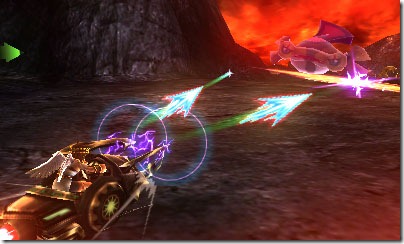
The Exo Tank

 Kid Icarus: Uprising is ultimately a high-energy and enjoyable experience, combining whimsical sights and sounds and delivering an experience quite unlike anything you’ve seen before. While the gameplay isn’t the most engaging thing in the world for me, it’s still fun, and the entertaining cast of characters and crazy scenarios the game threw at me kept me interested until the end. Perhaps most importantly, the game is a fiercely refreshing change of pace from all the assembly-line Mario games Nintendo has been turning out recently. Featuring a unique and interesting world, entertaining and likeable characters, and a unique new style of play for an old franchise, Kid Icarus: Uprising is one of Nintendo’s most unique and ambitious new games in years. Despite some blemishes in the overall experience, I’d still heartily recommend this game to all 3DS owners.