The Super Nintendo was never a big part of my childhood. I remember barely glimpsing games like Super Mario World and Donkey Kong Country, but somehow a SNES of my own never fell into my hands. I experienced many SNES classics when I was older (mainly thanks to Game Boy Advance ports and the Wii's Virtual Console, and eventually an original Super Nintendo console of my own), but I've always regretted not having these experiences when I was much younger, as many titles that are incredibly nostalgic for other people from my generation don't mean quite as much for me. I can distinctly recall wanting desperately to play one SNES game in particular: Super Mario World 2: Yoshi's Island. The colorful graphics and whimsical characters held a big attraction for me. Besides briefly getting to play the game at a childhood friend's house, I didn't get to fully experience Yoshi's Island until years later with the GBA port, and again on an actual Super Nintendo the past week.
Yoshi's Island is a very special video game. It's a work that embodies childhood creativity in its unique art direction, plot, and creative level designs and I ultimately think that it's a game that appeals to just about anyone who is a part of the human race. Visually, Yoshi's Island might be the most beautiful game on the SNES and it still looks fantastic today. It truly hasn't aged a day. The environments, backgrounds, and characters in the game all look like they've been sketched with colored pencils, crayons, and pastels and the result is a whimsical, imaginative paradise. Coupled with the game's great, though small, soundtrack, the game also has a really terrific atmosphere. The game's
main level theme is the happiest song on the planet and always puts me in a good mood whenever I hear it. The atmospheric
cave theme gives levels an adventurous, spelunking feel. The
castle theme might be my favorite castle music in the entire Mario series and finally the
world map music might follow suit, as it's such a simple yet catchy melody that adds a new instrument every time the player clears a world, building and building in tempo so one really feels like they are progressing on an adventure.
 |
| The level map is simple, but charming |
Yoshi's Island may carry the "Super Mario World 2" title, but I'm pretty sure that it is solely there for marketing purposes, as the game is entirely unique in the Mario series (not counting the later seuqels to the game) and a totally different experience than its SNES predecessor. Players control not just one Yoshi, but a variety of different-colored Yoshis as they ferry baby Mario on a quest to reunite the infant with his kidnapped twin brother, Luigi. Yoshi can't technically die, but when he (or she?) gets hit by an enemy, he'll lose baby Mario and a timer will begin counting down as the toddler floats about in a bubble, ceaselessly wailing until Yoshi reacquires him. Baby Mario's crying can become immensely,
painfully annoying (more on that later), but it does add a great sense of urgency when Yoshi loses him, as well a punishment for failure. The crying and the beeping of the timer becomes louder and faster as it reaches closer to zero, at which point Kamek's (the Magikoopa villain responsible for kidnapping baby Luigi) minions will come and swoop baby Mario off to join his brother in the Kingdom of Koopa.
Yoshi feels wonderful to control. He has a springy, fluid feel to his control that Mario lacks, and Yoshi can also perform a flutter jump in order to hover through the air to avoid obstacles and pits. Yoshi doesn't have a run button like in traditional Mario sidescrollers, but he doesn't need one. The game is a slower-paced platformer, and levels aren't designed to be rushed through. Yoshi's speed is just fine anyway, and he begins to run when you simply hold down a directional button, so there's no worrying about having to hold down the B or Y button all the time. Besides the platforming, the main gameplay element in Yoshi's Island is the dinosaur's ability to scoop up just about any creature in his way with his tongue, digest them, and turn them into an egg. There's a certain sadistic pleasure in gobbling up cheery, smiling critters like skipping, singing sunflowers who look like they are doing nothing but enjoying life until...SLURP! Yoshi can store up to six of these eggs and use them as ammunition to throw at bigger enemies, collect objects, find secrets, and solve puzzles.
 |
| Yoshi's Island looks gorgeous |
Yes, puzzles. You see, Yoshi's Island is a totally different kind of platformer than a traditional Mario sidescroller. Levels are far more intricately designed than those in the original Super Mario World. The levels in Yoshi's Island are huge, sometimes labyrinthine, and are designed to be explored, full of secret items, rooms, areas, etc. Super Mario World also has secrets, but instead of offering tons of secret levels like that game does, Yoshi's Island packs all that content into fewer, but larger and more detailed levels. Some levels aren't necessarily about simply getting to the end, but rather about
finding the way to the end (this is especially true of many of the cave levels, which are some of my favorites in the game). The fortresses and castles are especially worthy of note as they feel like true, complex dungeons at times, offering multiple paths, doors, and problems to be overcome. They are probably the most well-designed castles in the entire Mario series; each one feels like a different experience and is very satisfying to fully conquer. The boss fights in the game are all very satisfying and creative as well. Even though most of the bosses are enlarged versions of standard baddies, their giant forms still often have a unique visual design and their battle usually requires finding a weakness and exploiting it, rather than simply jumping on something's head three times. These bosses don't feel lazy like the bosses in the original Donkey Kong Country, which are also gigantic versions of regular enemies, and they also require some level of strategy and feel smarter than your usual Mario boss battle.
Almost every single level in Yoshi's Island offers something new that hasn't been seen yet in the game, like Shy Guys on Stilts! Or the
infamous fuzzies that send Yoshi into a hallucinogenic, wobbly state every time he touches or eats one. Yoshi can also gain the ability to temporarily turn into cute little Yoshi vehicles, like a helicopter and a mole tank, in certain levels. Needless to say, there's plenty of variety, unique elements, and interesting level designs that keep the player engaged throughout.
 |
| HeliYoshi! |
The gameplay in Yoshi's Island is near-perfect, however I do feel that the control for throwing eggs could have been improved, and very simply too. When aiming with an egg, a cursor constantly moves in a semi-circle in front of Yoshi and the egg flys in whatever direction the cursor is in when the player presses the correct button. The cursor can be locked in place to make things easier, but oftentimes when I'd have to aim at a very specific place in a pinch the fact that the cursor can't be freely controlled and instead contantly moves made things needlessly cumbersome sometimes. The cursor's movement could have easily been mapped to Up and Down on the D-pad so that it could be freely controlled instead of in constant motion and I can't think of any reason why this simple alteration wouldn't improve the play control when throwing the eggs.
 |
| Egg-throwin' |
So everything is cheery, fluttery sunshine when it comes to Yoshi's Island, right? Colorful, imaginative, tons of fun, and well-designed, what could go wrong? Well, there's one big issue I have with this game.
Most levels in the game can be completed by moving through them from start to finish like a traditional platformer, but they are designed to be played at a slower clip, with many, many secret keys, rooms, and places to discover. I actually really like this sort of exploration-based design. In order to complete the game 100%, the player must find the 20 red coins hidden among the normal yellow ones and five flowers in every level, as well as complete each level with 30 stars (number of stars=number of time on the countdown when baby Mario is lost; you can have 30 maximum). The level design encourages the player to achieve this goal, as some levels can be completed fairly simply by just getting through them and avoiding all the goodies, but their true challenge comes from trying to collect everything. This is also where Yoshi's Island goes from being a happy-go-lucky, charming little platformer to a frustrating, grueling venture. And this leads us to my one big issue:
at times, Yoshi's Island is one of the most frustrating video games I have ever played.
Yoshi's Island is a special kind of hell, and in order to demonstrate why I'll just provide an example. Sometimes, it feels like the designers purposefully designed the levels to be as annoying and frustrating for the player as possible. On one level, I had to guide Yoshi through a simple-enough straightforward field. This field was adorned with several small pits. Above, a Lakitu riding around in his cloud is throwing spiky balls at me, while behind me, Shy-Guys are endlessly jumping out of a pipe. All the while I'm trying to target a Shy-Guy flying up above holding a red coin, which if I don't hit in a matter of seconds, will fly away with the red coin and never come back, destroying my chances of fully completing the level. In the midst of all this,
something inevitably hits Yoshi, at which point baby Mario starts flying away and wailing into my fragile ears. I flutter jump across one of the small pits to claim him, only to be confronted with a stream of bubbles spat from the mouth of a skipping sentient flower creature that pushes Yoshi back and directly into the bottomless pit.
And all the while the incredibly ironic
cheery music seems to mock me.
And thus I get sent all the way back to the last checkpoint, which I feel are sometimes too few and far between in the game's long levels. And this is to say nothing of some of the game's secret unlockable stages, which are not designed to merely challenge, but to drive the player into a flaming rage inferno of controller-hurling, TV-punching insanity (one of these special stages involving a dog named Poochy that Yoshi can ride on feels broken as the stage relies on the dog's AI and it just doesn't feel sharp enough). I swear, one moment I'm having the time of my life in Yoshi's Island, flutter-jumping about and exploring the interesting levels with a big grin on my face, and the next I am
literally screaming, followed swiftly by rage-quitting. I'm not kidding.
 |
| These monkeys will drive you bananas |
To be fair, most of this frustration comes from the admittedly optional and very taxing quest to gather all the red coins and flowers, as well as finish each stage with the max 30 stars. Stars can thankfully be restored at the end of the level if the player has a +10 or +20 stars power-up, which are easy to farm for when certain mini-games are permanently unlocked and can then be stored to be used when you need them. And you will need them; if the game didn't have these star power-ups, I never would have had the patience to complete every level with all stars intact, which would mean retaining 30 stars until the end of the level, where one hit right near the goal ring and no way to get any more stars would spell failure (you always have a minimum of ten stars, but above that, stars don't recover on their own if Yoshi gets damaged and stars must be found in each level to get back to 30). All bosses, however, must still be beaten without getting hit once, since these star power-ups are banned in boss fights.
This whole collection process is designed in a "high score" way so that even if you miss one red coin, your final score for that level will be 99/100 and you have to do the entire level over again, and collect everything
all over again. Single collectables don't save: it's all or nothing. As I already mentioned, some red coins are carried by flying Shy-Guys (or Fly-Guys), who briefly appear on the screen and fly away a second later. If you miss them, you have to either kill yourself and restart from the last checkpoint or complete the level and then do it all again to get 100%. Having a system like this and having certain collectables be very,
very easy to permanently miss either because you couldn't hit a target fast enough or because you moved off-screen too much and completely didn't see the Fly-Guy altogether is
so. fricking. cheap. Other times I would reach the goal at the end of a level missing a flower or a coin, and on some levels there is no turning back and not even a way to commit suicide so I could go back to the last checkpoint. I can't even quit out of the level if I haven't finished it yet. I have no choice but to go ahead and finish the level, only to agonizingly see a 99% score and know that I have to waste another twenty minutes going through the whole level again, collecting everything again. Either that or I turn the SNES off in rage. One level right at the end of the game even punished me for being curious and going down a seemingly random pipe in the middle of my path, only to be taken to the end of the level with no way to turn back and collect the one or two things that I missed. After screaming into my hands for a while and taking a few deep breaths, I then did the whole level over again, this time being extra careful to get everything before going down that damn pipe. I wish the designers had been conscious of this sort of situation and added in something like a bottomless pit right near the level's end, so I could at least sacrifice a life to go back to the goal ring and collect what I had missed.
Having to replay levels, re-collect everything, and try over and over again like this just pads out the game. It isn't challenging, fun, or well-designed in my eyes. Just immensely frustrating. And that baby's cries
will drive you mad. Again, I do want to stress that this is still all optional, and therefore choosing to finish the game without getting a perfect score on every level is very possible and might even be the better choice. But how can you pass up all those secrets? The levels encourage exploration and I feel like the collectables give an incentive to explore. Despite it being so tedious at times, exploring and striving for 100% in each level is a big part of the game and I feel like one is missing half the experience if they ignore all this. I think this kind of exploring and collecting system can and has been done well in other Mario games and in other platformers in general. For example, in Donkey Kong Country Returns for the Wii, I had a lot of fun returning to completed levels to find hidden puzzle pieces, and after I got a piece, it was saved and I never had to re-collect it again (although the K-O-N-G letters in each level all had to be collected in one go, but I thought this was a fair enough challenge and also distinguished this task from the puzzle pieces. And the letters are also only four collectables instead of twenty red coins and five flowers). Also, the levels in DKCR are more straightforward and that game is a faster-paced platformer overall. Yoshi's Island's levels are long and plodding and there are many collectables that need to be gathered all in one go, so going through everything again can be a pain, even if the levels themselves are well-designed and fun.
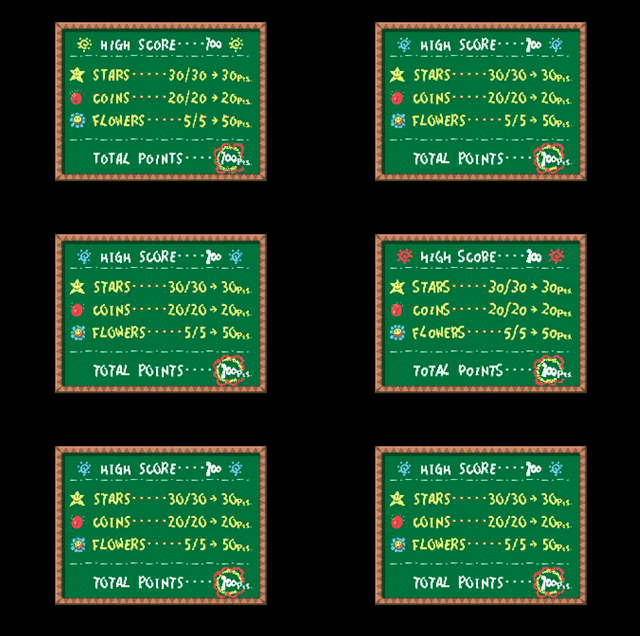 |
| The score-card that appears at the end of each level. Miss one thing and you have to do it all over again if you want to get 100 points. |
Finishing Yoshi's Island 100% felt more like a relief than an accomplishment. The player can unlock a single bonus stage and a single bonus mini-game for every world they fully complete, but some of the bonus stages, as I already mentioned, are some of the most frustrating levels of them all and must also be completed with all the same collectables in order to
fully complete the game, which you get nothing for except six stars on the title screen: one for each world thoroughly completed.
Despite me kicking and screaming my way through a decent portion of this game, the rest of my time with Yoshi's Island (which was the majority) was pure bliss. For every mind-numbingly frustrating level, there were five very interesting and very enjoyable ones. The game's aesthetic appeal alone is enough to recommend it, but behind that is also a very well-crafted platformer full of secrets and interesting levels. Ultimately, the best way to sum up Yoshi's Island comes from a special message that can be found in one of the game's many secret rooms, a brief message from the game's developers that proclaims that they poured their hearts and souls into the game for our enjoyment. And that's what Yoshi's Island is positively overflowing with: heart and soul. It's a Nintendo masterpiece from a time when every new game the company put out may have contained some similar faces, but was an entirely new, wildly creative experience, and oftentimes a genre and industry-defining one. It's from a time when Shigeru Miyamoto was still constantly upping tea-tables, instead of letting his most-beloved series settle for
stale-feeling sequels year after year that do little more than add a new cute animal suit and local co-op multiplayer features that would have been revolutionary twenty years ago. These games that Nintendo has been assembly-lining out for the past couple years are fun, but they lack what Yoshi's Island has in droves: heart and soul.
 |
| Something many of Nintendo's newer Mario games are definitely lacking |
The fact that Nintendo is now
adding the "New" moniker to the latest sequel to Yoshi's beloved SNES classic is the ultimate insult to the game's legacy and the perfect example of how Nintendo has recently lost sight of what made them so legendary in the video game sphere back in the late '80s, throughout the '90s, and into the early '00s; that is, boldy creative, exceptionally designed, unique video game experiences that often defined certain genres. Yoshi's New Island looks to be copying and pasting elements from the original and just like the New Super Mario Bros. series, ironically looks to be offering not much actually new.
Yoshi's Island probably isn't a game that I'll go back to as much as Super Mario World or any of the other old-school 2D Mario platformers, and certainly isn't one I'll likely ever attempt to 100% complete again. Its levels are large and intricate, and attempting to fully see and do everything in the game takes a massive level of patience. Super Mario World is a simpler platformer that boils things down to a few essential elements and features pure, elegantly simple level design. I'm not saying one game is really better than the other; they are just very different from each other, and unique and special in their own way. Yoshi's Island can be a deceptively grueling patience-tester, especially if you attempt to see and do everything in the game, but it's also unabashedly fun and creative and full of imaginative spark. It's one of the best platformers I've ever played. It's beautiful, joyous, and embodies a sense of imaginative wonder that only certain video games can deliver.


