Showing posts with label sega. Show all posts

Friday, October 7, 2016

My Top 115 Favorite Video Games (10-4)

The top ten begins today in the penultimate post of both this countdown and this blog. Click here to head all the way back to the introduction of this project and see where it all began before heading into the conclusion. It's a bit of a lengthier post today as this is the top ten after all and I wanted to take extra care to accurately describe just how much each of these immensely special games means to me. I hope you enjoy reading, and as always, reminiscing about some of your own memories you might have with these titles!

Without further ado, here are my current top ten favorite video games:

10. The Legend of Zelda: Ocarina of Time (N64)


In some nearly forgotten, lost pocket of time existing somewhere between 1998 and 1999, I briefly spent a few hours being confused and frightened by The Legend of Zelda: Ocarina of Time. I did not understand it, I could not pronounce “Hyrule”, the Stalchildren that appeared at night freaked me out, the Peahats that appeared during the day freaked me out. Hyrule Field felt vast and threatening, so I took shelter in villages where I felt safe…until I encountered a giant golden spider scuffling on a wall and found my way into the Royal Family’s Tomb, where I encountered this. I did not yet “get” this Zelda thing, but even so there was something mystical about my brief sojourn wandering around Hyrule as child Link; it was exciting when I found a secret passage connecting the Lost Woods and Death Mountain, bizarre elements like “Happy Masks” intrigued me, and I longed to see what lay on the other side of the map in the distant lands of Lake Hylia and Gerudo Valley. I can’t fully explain to you why I did not take the plunge and buy the game to further explore these mysteries, but I think it comes back to me being intimated and frightened by it all. Whatever the reason, I returned the game to where I’d rented it from (or borrowed it from?) and wouldn’t revisit Ocarina of Time until 2003, on the eve of the release of The Wind Waker.

When I finally did sit down to properly play Ocarina of Time via the GameCube version released as a pre-order bonus for The Wind Waker, I was older and wiser, I had experience with Link’s Awakening, Majora’s Mask, and A Link to the Past and was now eagerly anticipating the upcoming and beautiful-looking The Wind Waker, and I went into the N64 classic knowing full well its reputation and how foolish I was for passing it up several years prior. I was immediately taken aback by the title screen, the tranquil scene of link riding Epona through Hyrule Field at dawn with a contemplative piece of music playing. There was something unexpectedly subtle about the opening that caught me off guard and already a powerful emotion overcame me. It’s like they knew, I thought at the time. Knew what?

That Ocarina of Time was one of the greatest video games ever created.
It took me roughly two weeks to see the whole adventure through that first playthrough (I’ve lost count of subsequent playthroughs) and the experience lived up to it all. Ocarina of Time is just an amazing and special game. There are few games, or perhaps none, that feel as confident in their execution and that unwind as elegantly as Ocarina, where everything locks into place just so, in such perfect strokes. Ocarina of Time is a beautifully-spun metaphor about growing up. The game does this magic thing where when you’re child Link, you feel like a child: the world is brighter and livelier, and everything seems bigger. You’re just a kid playing games, going on adventures, and making friends. Then the transition to adulthood happens, and while I still want to stray away from spoilers, suffice it to say the world suddenly seems smaller, bleaker; your friends are suddenly more important than ever, and now your adventure is no longer a game but a crucially important quest, one with burden and responsibility. This theme is poetically and artfully worked throughout the entire experience, and it’s one of the reasons why I feel Ocarina of Time still has some of the best storytelling in the whole Zelda series. There’s so much more I’d like to tell you about Ocarina of Time: how I love its dense and cozy world, how magical its music is, how its finale is my favorite in all of video games, how perfect its ending scene is, what it felt like to enter the Forest Temple for the first time, what it felt like to finally reach Gerudo Valley and hear that music for the first time, how I’m tearing up just thinking of it all right now…but I’ve gone on long enough, and this is only number 10.


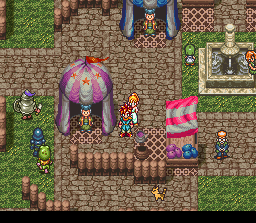
Chrono Trigger is unlike any other RPG or adventure game I have ever played. It just has this vibe…this inexplicable vibe that is difficult to grasp. The game is undoubtedly incredibly charming, for starters, featuring perhaps my favorite cast of central characters in any game, a colorful line-up of personalities that include technological genius, Lucca, chivalrous frog knight, Frog, and prehistoric matriarch, Ayla. The central time travel theme and the concept of visiting a planet’s life throughout several different stages of its history in order to learn how it became doomed and what must be done to save it was and still is original and largely unexplored territory in interactive entertainment and just a brilliant concept besides. The total surface area of the world in Chrono Trigger is actually pretty small compared to most other RPGs, but the excitement comes from exploring “vertically” and seeing how the planet changes throughout history as opposed to exploring “horizontally” across a wide area of land. The whole adventure is excellently-paced, the battle system is innovative and never feels like it bogs down the experience (partly thanks to the game dispersing with random battles), and the art and spritework is colorful and lively. Chrono Trigger is overall a journey that constantly surprises, delights, and engages around every corner.

But you know what my favorite part of Chrono Trigger is? You know what I think is perhaps the most important factor that determines that special “vibe” I mentioned? Music. I’ve brought up music a lot throughout this list, whether in regards to how important a specific game’s soundtrack is to the overall experience for me or how large a role music plays in my enjoyment of video games in general. While it might be dishonest of me to make such a definitive assertion, Chrono Trigger’s musical score has long been what I consider to be my favorite video game soundtrack of all. The game’s characters are partly so endearing because each one has their own musical motif, each time period comes alive with its own unique sound, and there are so many moments, so many perfect, beautiful moments that are so perfect and beautiful because a perfectly-suited piece of music kicks in at just the right time. The ending credits theme, “To Far Away Times”, might be my favorite single composition in video game history. Yasunori Mitsuda, the brilliant composer behind Chrono Trigger and later Chrono Cross (among other titles), poured everything he had into this soundtrack and damn does it show. Chrono Trigger is an experience that has largely stuck with me so much because of its music, and it’s a score that has basically become the soundtrack to my own life as I constantly go back to listen to it in the car, on walks, when I’m writing, when I’m drawing, when I’m in lying in bed, when I’m cleaning, when I’m dreaming, and of course right now as I write this. Chrono Trigger is a wonderful game in every respect, but its music especially is a part of my soul.


Silent Hill 2 has the best storytelling of any video game I’ve ever played. It is one of very few games that I know of where narrative seems to not only have been an extremely important focus in development, but indeed the primary focus. This isn’t a case where there’s a few hours of compelling story delivered through cutscenes intermixed with divorced gameplay sections, but rather the rare video game where almost everything serves the story. There are still cutscenes in Silent Hill 2, but the storytelling does not end when control returns to the player; every location, every monster, every moment has significance, and if something doesn’t directly influence the central narrative, than it fleshes out the universe in some way, which in turn also enhances the central story. Nothing is random and Silent Hill 2 is drenched in symbolism in an artistic way that no other video game I’ve encountered can parallel.

Disconnecting itself completely from the first Silent Hill’s narrative, SH2 follows James Sunderland, a man wrecked by grief who receives a letter from his late wife, Mary, who died three years prior to a deadly disease (it’s never named, but I assume cancer). The letter beckons James to the couple’s “special place”, the lakeside resort town of Silent Hill, and as we journey with James into the fog-enshrouded, seemingly abandoned town, we meet a variety of other troubled characters and spend a lot of alone time with our protagonist as he tries to come to grips with what appears to be reality breaking down around him. As James delves deeper and deeper into horrors that begin to slowly feel less and less external, I feel myself getting pulled down with him; as sweat beads on my forehead at 2AM as I huddle in a dark corner of a grimy hospital or walk down a dark flight of stairs that seems impossibly long, I feel a player-protagonist connection unlike any other. This is my journey just as much as it is James’s, and as this focused experience winds towards its conclusion, I feel a closeness and an empathy for James and his tormented friends few other games have ever matched for me. As the credits role, there are always tears in my eyes.

Silent Hill 2 also has a very unique atmosphere among its brethren. For one thing, largely unlike its predecessors, SH2 doesn’t feel like it’s “horror all the time” but rather contains several “relaxed” moments that while still fitting the horror theme, just feel…different somehow. There’s a feeling of deep loneliness and stagnation to the game, and some have even likened the experience as a whole to depression, which I feel is an incredibly appropriate reading. This atmosphere is of course heavily supported by the bleak and dreary art design and the unforgettable soundtrack, which probably unsurprisingly is one of my favorites in anything ever. All of this too serves the narrative, but I also think this “feeling” that Silent Hill 2 has is one of the main reasons this entry in the Silent Hill series in particular has left such a strong impression on so many people; I can at least say that this is largely the case for myself.

As a thoughtful human story, one that deals with taboo subjects in a mature way rarely seen in this medium, Silent Hill 2 was not only way ahead of its time, but is still ahead of the curve today compared to most other games. As an atmospheric feeling, it is uniquely dreary and affecting. And as a piece of horror fiction, as my favorite piece of horror fiction in fact, it has left a scar on me. I watched my older brother play almost the entirety of the original Silent Hill when it first came out, but I couldn’t even stand to watch him journey that deep into the early apartment building area in Silent Hill 2. There was something about this game that kept me up at night even just knowing it was being played in the other room. I avoided Silent Hill 2 for years until it finally called me back to it when I was a sophomore in college. I said before that I probably consider the first Silent Hill to be the “scariest” in the series, and Silent Hill 3 is probably the most viscerally unnerving, but Silent Hill 2 is the most lingering. I used to see an advertisement for the game in Electronic Gaming Monthly around the time it released that I would actively try to avoid looking at. “Wounds will heal…” it read, “…but your mind will be scarred forever.” To this day I still catch myself every so often having a bizarre nightmare of being trapped in a hellish hospital as unfathomable creatures, including a hulking Pyramid-headed one, stalk me in the dark.

NOTE: This blurb originally contained a line relating different colors to different Silent Hill games, but I removed it because it was similar to an idea contained in YouTube creator Jordan Underneath’s Silent Hill 3 video, "Silent Hill 3 and the Worst Movie Ever". When I originally wrote this, I suppose I was thinking of this idea as a kind of universal truth about the Silent Hill games (I really can’t remember if I necessarily got the idea from Jordan’s video or also had it on my own before watching his video) but have since reconsidered and out of respect for Jordan’s work, and to avoid the risk of stealing his idea, I’ve decided to take the line out. While I'm sometimes inspired or gain knowledge from other creators, I always strive to use my own words and ideas. Also, when I mentioned that some have likened Silent Hill 2 to depression, I was talking about Jordan’s brilliant video on Silent Hill 2 (appropriately titled "Silent Hill 2 and Depression"), which I originally linked to but Jordan has since removed. After a re-branding of his YouTube channel, Jordan has since deleted all of his video game-related videos, including his Silent Hill videos, but you can check out his newer, more artistic videos on his channel, “Jordan’s House” (I highly recommend you do as well, as his surreal, atmospheric short films are really something special). While I highly doubt Jordan will ever see this, I nevertheless apologize to him if it seemed like I was trying to steal his idea, which absolutely was not my conscious intention.


As I clutched onto the back of a gargantuan bird soaring over a vast lake, the wind pummeling me and the creature ferociously beating its great wings and spinning upside down in an attempt to shake me off, I knew I was experiencing a historic moment in video games. I knew Shadow of the Colossus would go on to be regarded as one of the greatest works in the medium. The sixteen colossus battles are varied, intelligently-designed, and easily some of the most emotionally epic encounters in any video game I’ve ever played (and are backed by an outstanding soundtrack), but when I think of Shadow of the Colossus, I just as readily think of the space between these stunning conflicts. Quiet, lonesome moments spent journeying across sprawling plains and vapid deserts with my only companion, my horse, Agro, who I found myself more attached to than any other companion-type character in video games. Discovering forgotten ruins on a mountain ridge, knocking apples off of a solemn tree on a seaside cliff, or simply marveling at the breadth and the wonder of it all…it’s these moments I cherish. In a somewhat similar way to Silent Hill 2, it is this lonely atmosphere that calls to me and connects me with Shadow of the Colossus, that creates a powerful kinship with the game in me, but the feeling present in both of these experiences is very different; Silent Hill 2 feels akin to depression, whereas Shadow of the Colossus feels more like contemplative isolation. Also like Silent Hill 2, except to an even greater degree, the minimalism and starkness of Shadow of the Colossus demonstrates the greatly untapped emotional potential of video games beyond film-like cutscenes, wordy scripts, and a neatly divided gameplay/story philosophy; Shadow of the Colossus lets you live its narrative, feel the pain of its protagonist, and feel the pain of every beast you slay. It is a marvelous experience that nothing has ever rivaled for me.


Adventure and discovery. Skies of Arcadia embodies adventure and discovery. Despite all the Dreamcast love on this list, I strangely did not actually play Skies of Arcadia on its debut console and instead played the 2003 GameCube Legends port, which is essentially the same game with a few tweaks here and there and a few extra sidequests. Skies of Arcadia is my favorite RPG; it’s everything I love about the genre contained in a single experience. I received Skies of Arcadia as a birthday gift in 2003 and was pulled into a world of adventure that didn’t let me go until very late that night, at which point I was already emotionally attached to the characters and the world. And what a world it is. I often criticize the lazy perpetuation of traditional video game environment clichés these days (forest, desert, ocean, etc.), but I’m not inherently against them, and if you want to see a game where these tropes are richly explored and used in an imaginative, effective way, look no further than Skies of Arcadia. The culturally and environmentally distinct lands of Arcadia make for an unforgettable world where the possibilities seem to be endless. It’s a world of floating continents and airships, air pirates and evil empires, of flying monsters and ancient weapons, lost civilizations and countless unsolved mysteries, of daring rogues and fierce friendships. It’s like some dream mixture of Star Wars, the works of Jules Verne, and the films of Hayao Miyazaki. Skies of Arcadia contains a fair bit of the usual JRPG clichés, but it also eschews many of them, particularly in regards to its overall positive and upbeat vibe and easy-to-follow but unpredictable narrative. The cast of upbeat characters is also simply darling, and in particular the three central characters of Vyse, Aika, and Fina are a group of tightly-bound friends who I grew to immensely love.

The beating heart of Skies of Arcadia undoubtedly lies in its sense of adventure, facilitated through a focus on exploration and discovery that is prevalent throughout almost every aspect of the game. The world of Arcadia is full of mysteries to ponder and discoveries to be made, hidden areas and nooks to uncover, dangerous bounties to hunt, and all myriad of secrets stowed in far-off corners of the world where who knows what lies in wait. My favorite sidequest in the game involves chronicling Discoveries made (each one providing a bit of lore and intrigue) and selling information about them. Eventually, you are able to recruit your own rogues’ gallery, build a base, and customize your own airship. Skies is simply one of the best times I’ve had exploring and discovering in a video game, and that’s really saying something for me. This central tenet of adventurous discovery is clearly manifested throughout Skies of Arcadia's wonderful soundtrack, and no more clearly than in the game's final traveling theme, which is my favorite in any game. The appeal of Skies of Arcadia largely lies in its traditional, swashbuckling atmosphere of adventure and discovery, but also in how it takes this familiar theme and builds a fantastic world beyond imagination around it, surprising and enamoring the player at every turn.

5. Sonic the Hedgehog 3 and Knuckles (Genesis)


When I think about what makes a great platformer for me, i.e. creative and memorable levels filled with secrets, a sense of connection and level-to-level progression, a non-intrusive but effective narrative, a moderate but non-frustrating challenge, and great art design and music, Sonic 3 and Knuckles, a.k.a. the true Sonic the Hedgehog 3 born when combining Sonic 3 with Sonic and Knuckles, immediately comes to mind. Picking up right where Sonic 2 left off both design and narrative-wise, Sonic 3 is a platforming legend that amazingly seems to often go overlooked in favor of Sonic 2 (probably in large part because of its weird double-game nature and relatively late release). The level design of Sonic 3 balances a satisfying sense of speed and momentum with more traditional platforming challenges more elegantly than ever before, the art design builds on the previous titles’ uniquely surreal but also realistic look culminating in what is one of my favorite retro aesthetics, the music is the height of classic Sega Genesis tunes, and I am still making new discoveries in this game’s massive and intricate stages to this day. I’ve always admired the creativity present in the Sonic series’ zones from a thematic perspective and Sonic 3 is the pinnacle of this imagination as Sonic and friends race through a vast sunken city, a vibrant amusement park metropolis, a dense season-changing forest, and an immense flying battleship, among so much more. Sonic 3 is also one gigantic, interconnected adventure as the end of each level seamlessly blends into the next area, creating a sense of cohesion and progress. The two individual Acts of each Zone also often differ from each other in dramatic ways and environments sometimes change in real time, like when Dr. Robotnik’s machines turn the jungles of Angel Island Zone into an inferno or when the bad doctor uses a giant drill to cause earthquakes that shift and alter the landscape of Marble Garden Zone. Even though the levels are more gigantic than ever before, nothing ever becomes stale because of this constant variety. The story of Sonic 3 is also subtly told not only through brief little “cutscenes” usually involving Knuckles messing with Sonic and Tails in some way, but also in the level themes themselves, such as Launch Base Zone, an inventive location where we can see Robotnik’s gigantic doomsday weapon, the Death Egg, being repaired in the background…before of course going back there in the second Act to try to stop it from launching. 

Indeed, much of the stuff I love about the brilliant Donkey Kong Country: Tropical Freeze, my favorite modern platformer, was present in Sonic 3 and Knuckles years prior. There is such a wonderful attention to detail in Sonic 3 and the result is a platformer that doesn’t just feel like a bunch of disconnected levels you hop and bop through to get to the goal, but rather an epic journey that feels incredibly satisfying when all is said and done. Besides all this, Sonic 3 and Knuckles seems to be a treasure trove of secrets waiting to be uncovered, and there was a real sense of mystery surrounding Sonic the Hedgehog 3 and Sonic and Knuckles when I was a kid. This partly stems from the fact that there are puzzling elements in the stand-alone Sonic 3 that betray its incomplete nature, such as mysterious unreachable paths that wouldn’t become fully explained until one could return to them with a playable Knuckles. Along with a Tails who could actually fly this time around, there are actually three playable characters who all feature a unified gameplay style but each have their own unique skills that allow them to reach new level sections; Knuckles’ story in particular, which takes place after the main events of the game, diverges dramatically from the route Sonic and Tails take. The series’ patented “Special Stages” are also finally not extremely difficult garbage and this is still the only Sonic game to date where I’m able to acquire every single Emerald and obtain all of the characters’ super forms the legitimate way…and I also enjoying doing so to boot! As an added bonus on top of everything else, Sonic 3 and Knuckles even has an interesting connection to Castle in the Sky, one of my favorite Hayao Miyazaki-directed films! I have no hesitation in saying that Sonic 3 and Knuckles is the absolute pinnacle of this series, a timeless platforming masterpiece, and also my personal favorite platformer of all time tied with the next game on this list, which is of course…


Super Mario Bros. 3 is my favorite Mario game, my favorite NES game, and my favorite platformer of all time tied with Sonic 3 and Knuckles. I have a nostalgic attachment to this game unlike any other and just beholding its yellow and blue boxart makes me melt, nevermind listening to any of its music or sound effects. It had a tremendous influence on my imagination as a child, and it continues to do so today. The game even initially released in Japan the year I was born and it came to the states on my second birthday; it was meant to be. It’s easy to retroactively look back at Super Mario Bros. 3 as basically the standard Super Mario title. After all, airships, the Koopalings, the familiar world themes, the raccoon tail, it’s all here, and it all started here. But that’s the key element: all of this was new in Mario 3, and back in 1988 this game was a powerhouse of invention that aside from bringing back Super Mushrooms, Goombas, and traditional platforming gameplay, was just as creative and weird and distinct as Super Mario Bros. 2 before it. While I heavily criticize just how much the Mario series constantly and nauseatingly recycles elements from Mario 3  today to the point where the whole Mario franchise has largely become stale and quite boring compared to what it once was, I don’t let that current reality sour this original masterpiece, which in addition to introducing all that stuff also does dozens of other wonderful little things that newer Super Mario titles don’t emulate and that make this game still far and beyond them all.

The creative genius of Super Mario Bros. 3 is in the details. Did you know the entire game is themed around a stage-play? That’s the context for those big blocks with screws in them; they’re stage props. A world map was introduced here, but it’s more than just a level select screen; it’s full of little secrets of its own and contains all sorts of neat interactive moments like being able to guide a rowboat out to some bonus islands in the water land. Then there’s the fifth world, which at first glance seems like just a small landmass with a mysterious spiraling tower at the far end of it. Climb that tower though and…. Yes, there’s a desert land and a water land that come second and third respectively, but besides this being the game that established that formula in the first place, it uses these themes with style and still manages to branch outside of them with some really imaginative ideas for the time, like a world where all the sprites are mega-sized. The narrative also isn’t just Bowser kidnapping the princess, which doesn’t actually happen until the very end of the game in this one, but instead sees the plumber brothers venturing outside the Mushroom Kingdom proper to the larger Mushroom World, where the various kings of different lands have been transformed into dogs and seals and spiders and all manner of other creatures by the nasty magic wand-wielding Koopalings. Another element that I admire about Mario 3, and actually something I admire about all three NES Super Mario games (four counting The Lost Levels), is atmosphere. I described the original Super Mario Bros. as having a uniquely stark and weighty atmosphere and a similar kind of feeling extends to its NES successors as well. The castles and airships feel truly foreboding in Mario 3, there’s a sense of mystique surrounding certain areas like the ice land (which is embodied in its theme music), and the world as a whole just seems to feel more immersive in a way.  I actually just played through most of Super Mario Bros. 3 this past weekend and it always amazes me not only how varied and memorable each level is considering the limited tech at the time, but also how, similar to Sonic 3, I’m still finding new secrets in this game to this day. Like the original Super Mario Bros., Super Mario Bros. 3 is a game that I can return to and play through at any time and always immensely enjoy, and each experience also always seems to bring new discoveries.

Super Mario Bros. 3 was, to put it plainly, the game that I wanted to play throughout my childhood. Like, all the time, over anything else. I owned it myself for a brief period of time, but I mostly remember relying on outside sources. If someone had Mario 3, I wanted to visit them and play it, and if I went somewhere and someone had Mario 3, I had to play it. Before the days of the Virtual Console and re-releases, there was a long period of time where I dreamed of someday having ready access to this game. Nowadays I own Mario 3 in just about every way one can and I feel like I take such an unbelievably wonderful thing for granted. I didn’t actually fully complete the whole game until the Game Boy Advance port (which is based on the SNES Super Mario All-Stars remake), and while I love every version of this game, I definitely prefer the original NES one, which I find leaves a lot more to the imagination in regards to its visuals and atmosphere. Also nostalgia. Warm, fuzzy, lovely nostalgia. When it comes to my favorite entries in several of my other favorite video game series, I have to put some thought into it and often wind up with a lot of ties or no clear winner at all, but throughout my life Super Mario Bros. 3 has always been my favorite Mario game. There’s never really been any question; I just love this game with all my being.

---

Phew! I thank you if you took the time to read all that, or even if you read any of it! Clearly, these seven games are incredibly important to me, but there are still three more yet.... Next time, please join me for the big finale as I close the doors of The Stock Pot Inn with a grand celebration of my three favorite games of all time. 

Yes, please join me for the Carnival of Time.

Friday, September 30, 2016

My Top 115 Favorite Video Games (15-11)

Click here for the introduction!

15. Okami (PS2)


Some people call Okami “the best Zelda game Nintendo never made”, but I don’t think that does the game justice. Yes, in terms of its structure and feel Okami definitely takes inspiration from my favorite video game series, but similar to Beyond Good and Evil it is also a uniquely brilliant game in its own right. The level of artistry on every level of Okami is awe-inspiring. The art design is breathtaking, the musical score is wonderful, and the Celestial Brush is one of the most inventive mechanics in video games. The world, a fantastical version of Japan, is a layered land of wonders and the narrative and endearing characters truly moved me in a way that only a handful of games, or any works for that matter, have ever done. There are few feelings as magical as dashing through the fields of Nippon as Amaterasu as flowers bloom in my wake. The way mechanics, art design, and the central narrative themes of good vs. evil and restoring nature all come together in Okami is nothing short of poetic, and more than just an endlessly imaginative journey, Okami feels like a lifetime. Okami is a video game masterpiece if there ever was one.

14. Shenmue (Dreamcast)


There has never been a video game that has amazed me as much as Shenmue did in 2000. It was way ahead of its time and revolutionary in many ways. Many video games strive for realism, and while graphical prowess has continued to evolve, few feature a world that truly feels “real”. With its dense, yet hyper-detailed world, Shenmue felt like I actually lived in Japan throughout my duration of playing it. It appealed to me because of my interest in eastern culture, but the magic of Shenmue is also in the mundanity of it. I mentioned when talking about Animal Crossing that despite it being a very unique experience, there was actually another game somewhat similar to it that I had played previously. I was referring, of course, to Shenmue, and like Animal Crossing, it is the simple act of living a life day to day that makes Shenmue so special. In other words, it’s another game where “downtime” is the focus. I could walk around Ryo Hazuki’s house and open every drawer, I could buy and drink soda from a vending machine (and even inspect the cans), I could enter a convenience store and browse through different packets of noodles, or I could waste hours buying toy capsules from a machine outside of it. I could play classic Sega games at the local arcade, I had a daily allowance from my sweet housekeeper, I went to work, I practiced martial arts in the park, and I could talk to a wide variety of other people living their lives (and at the time, I was astounded by the sheer amount of voice acting in the game). Shenmue immersed me in its ordinary yet foreign world, it made me want to travel, it catered to my love of Japanese culture, and it made me gain more of an appreciation for other cultures in general. The sense of realism in the game, the wide degree of interactivity, the atmosphere, the ambitious storytelling…Shenmue was and still is in a league of its own and is an experience that will always stick with me.

13. Super Mario 64 (N64)


I don’t specifically remember the very first time I played Super Mario 64, but I remember the time period. The Sony PlayStation and Nintendo 64 were taking console video games into a bold new dimension, and everyone on the N64 side was either playing Wave Race 64 or Super Mario 64. Mario 64 truly felt massive back then, with an intricate, labyrinthine overworld full of secrets and what seemed like a never-ending supply of colorful and imaginative levels to explore. I remember even being taken aback by the peaceful courtyard of Peach’s Castle; Mario’s world had come to life in a way it never had before. Super Mario 64 is a playground; it’s a joyous, bounding experience in which it is a wonder to just move around. That’s perhaps what I remember most about my initial experience with the game: just how damn good it felt to move Mario around in 3D, to do backflips and triple jumps and climb trees. I’ve gone back to 64 in the past simply to run and jump around just for the hell of it. Super Mario 64 is more than just great control though. Its many worlds feel like the epitome of classic Super Mario themes (which, for the record, I don’t inherently hate) and all of them are jam-packed with memorable moments, like the terrifying piano in Big Boo’s Haunt, exploring the pyramid in Shifting Sand Land, and finding the hidden town in Wet-Dry World. Beyond the worlds is the brilliantly-designed hub from which you access them: Peach’s Castle, which might be my favorite thing about the whole game. There are just so many secrets and little details to discover inside and outside the castle: the secret aquarium, looking at the sun in the lobby, following a Big Boo and leaping into a birdcage to access a new world, not to mention the surprise waiting on the roof…so much effort was put into making the hub just as interesting to play around in as the levels themselves. Mario 64’s Koji Kondo-composed soundtrack is also one of my absolute favorites in the series, with “Dire, Dire Docks” and “Koopa’s Road” being particular highlights. The game’s colorful art and smooth, simple geometry also really stood out to me back then over the grainy, jaggy PS1 visuals and still holds up pretty well today despite the obviously dated technical aspects. It’s amazing that Nintendo got 3D Super Mario so right right out of the gate and paved the way for intuitive 3D control in video games with this one exceptional title.

12. Super Mario Bros. (NES)


Super Mario 64 changed the game in a major way, but there might not be a game at all if it wasn’t for Super Mario Bros., which essentially saved video games from a tragic early demise and is in my opinion basically the moment that video games stopped being merely “games” and started being works of art. It is also one of my earliest gaming memories along with Sonic the Hedgehog and Kirby’s Dream Land and very likely the first video game I ever played. Super Mario Bros. is basically the reason I care about video games at all. Video games were no longer a single screen with simple rules and only a few actions, they weren’t merely about getting a high score anymore; Super Mario Bros. was an adventure over land, air, and sea, it was a fantastical world, it had a story to it, there was a beginning and an ending. The first major post on this blog that I wrote four years ago was a breakdown detailing how Super Mario Bros. basically contains all of the core elements that make me love video games so much, and while I’m not sure I’d break it down into such a cut and dry list anymore, I still basically feel the same way; hell it even has the kind of progression and level-to-level connection that I love in platformers so much. Not only is Super Mario Bros. a game that I can go back to and play at any time, at any place, at any point in my life and get an immense amount of enjoyment out of, but there’s something about the stark atmosphere of Mario’s original Mushroom Kingdom adventure that I really love. I love the idea, whether official or not, of two plumbers supposedly stumbling upon a surreal fantasy world that has been conquered and brought to ruin by a fascist turtle monster (a set-up that the infamous 1993 film was actually surprisingly pretty “faithful” to) and whether intentional or merely a byproduct of the limited technology of the time, there’s a mystery and somewhat somber vibe about this game that was largely lost the more the series went on. The game’s narrative premise and backdrop of what essentially is a post-apocalyptic Mushroom Kingdom is at least a fair bit more interesting than the “Bowser absconds with the Princess to lava land” routine that the series constantly recycles today. Of course, even though I consistently replay it and do think the game has aged wonderfully, I also simply cannot deny how large a role nostalgia plays in my undying love for Super Mario Bros., and every art asset, music track, and sound effect evokes powerful feelings deep within me. A masterpiece of surreal art, a masterpiece of game design and game feel, Super Mario Bros. simply is eternal.

11. Paper Mario: The Thousand-Year Door (GameCube)


When I think of Paper Mario: The Thousand-Year Door, I think of a cool Saturday morning in October, the sun gently falling through the window, a little bit of heat coming through the radiator, and exploring the mysteries of the Glitz Pit, where Mario had enlisted as a prize fighter and was trying to weed out seedy corruption in the floating entertainment center accompanied by a newly-hatched baby Yoshi with a spunky attitude. Around the same time, I remember proclaiming that The Thousand-Year Door was my favorite game of all time. It’s hard to put into words just how good this game truly is, but let me try: Paper Mario: The Thousand-Year Door is one of the most creative, subversive, and memorable games that not only Nintendo has ever made, but that I’ve ever played period. It is the complete antithesis to the staleness the Mario franchise largely wallows in today and I find it hard to believe that the current Nintendo even created a game like this once upon a time. Like the original Paper Mario, The Thousand-Year Door is comprised of several chapters, each complete with their own unique characters and subplots that all tie into a larger story, which in this game’s case involves the core mystery of what lies behind the sealed Thousand-Year Door that a secret society known as the X-Nauts want desperately to unlock for some reason. Unlike the first game’s more familiar Mushroom Kingdom setting, TTYD takes Mario to a bizarre new land where he sets foot in the risqué harbor town of Rogueport, which features a gallows as a centerpiece, is full of the Paper Mario universe’s versions of criminals, and even has its own mafia. From here, we meet a host of colorful and memorable characters and go on one captivating adventure after the next throughout one of the most interesting worlds Nintendo has ever created, from the aforementioned corrupt fighting arena, to a cursed town in the woods, to a murder mystery aboard a ritzy locomotive. That’s the key word: mystery. The Thousand-Year Door is like a series of short stories and every one of them is compelling and full of mystery and intrigue. On that note, TTYD probably has the best writing of any Nintendo game aside from some of the Zelda games (namely the ones Yoshiaki Koizumi was involved with such as Link’s Awakening and Majora’s Mask) and is also probably the funniest game the company has ever produced as well, and one of the funniest games I’ve ever played period. Even if you don’t care about Mario or Nintendo, you owe it to yourself to try this game out. This list is all about special games, and it really doesn’t get much more special than Paper Mario: The Thousand-Year Door.

---

We head into the top ten next time with #10-4, followed by the big finale!

Wednesday, September 28, 2016

My Top 115 Favorite Video Games (20-16)

Click here for the introduction!

20. Sonic the Hedgehog 2 (Genesis)


One day back in 199-something, my brother and I were playing a game that we’d rented (a frequent occurrence back then), when suddenly the news came that Sonic the Hedgehog 2 had arrived in the mail. “Forget this crap!” I remember one of us saying as we yanked that poor, forgotten rental out of our Sega Genesis. Sonic 2 was here and it took precedence over everything else. Sonic the Hedgehog 2 followed up the original classic with a bigger, faster, prettier game, and while these things don’t always mean a better game, in this case they did. The Sonic sequel cut each zone down to two acts insuring that no one theme would ever drag, its levels are better designed around Sonic’s speedy momentum-based platforming, its visuals are more vibrant and colorful, its soundtrack is arguably even more amazing, and it introduced Sonic’s signature spin-dash and sidekick Miles “Tails” Prower, and co-op play along with him. In addition, the iconic Super Sonic made his debut here, and while I’ll likely never unlock him the legit way, cheats have allowed me to experience what a fun hidden extra Sonic’s powered-up form is. The memories with Sonic 2 are too many to count. Memories of trying to get through the game on my own as a kid and many more of fumbling around as Tails while my brother played as Sonic. Every zone, every boss, every section of every level has a story: the terror of the polluted water in Chemical Plant Zone Act 2, the secret base at the bottom of Casino Night Zone, getting stuck on those damn nuts and bolts in Metropolis Zone. Sonic 2 is an anthem of my childhood, it’s a part of me, and I always make sure to set aside some time to run through it and its two Genesis counterparts every year or so. Where once upon a time, the harrowing final boss fights were a nightmare rarely glimpsed, now I can get through the game in just over an hour.

19. Dragon Quest VIII: Journey of the Cursed King (PS2)


Dragon Quest VIII is the quintessential traditional JRPG and one of the most finely-crafted and polished games I’ve ever played. There’s a “classic appeal” to this game, an old-school approach to fantasy perfected that I really dig: exploring pastoral countryside, traversing quaint little villages and talking to townsfolk at the local inn, exploring a cave with torch in hand, finding treasure, battling monsters…there’s a true sense of old-fashioned adventure in Journey of the Cursed King. The world in DQVIII is vast, and this was the first RPG I played where I wasn’t some little avatar running around a world map but where every inch of the actual world was explorable, up close and personal. It all looks and sounds so lovely too, with a colorful semi cel-shaded aesthetic and probably my favorite use of live orchestrated music in a game with its astoundingly beautiful score. This is also another refreshingly narratively straightforward JRPG, and this works well combined with the rest of the game’s clean, simplified approach. What makes the story truly come to life though is the lively characters and superb voice acting. The colorful cast of Dragon Quest VIII is brimming with personality and this is definitely one of the funniest and most charming games I’ve ever played. DQVIII also features traditional, yet refined mechanics and its battle system is one of my favorites in the genre for its purity and accessibility. It can be quite a retro challenge at times, but Dragon Quest VIII is simply an RPG masterwork and was the perfect adventure to completely immerse myself in during winter break after receiving it on Christmas morning in 2005, playing until the wee hours of the morning every night.

18. Half-Life 2 (PC)


My favorite games have a way of sticking with me, of taking up residence in my consciousness and every so often signaling their presence. A particular noise, a certain location, even a smell can trigger a memory, an association with a cherished experience. Half-Life 2 is one of these games, and also like many of my favorite games, it is entwined with a very particular time in my life; in this case, my first semester of college and the week leading up to it. Even with so many distractions around me, there are few games that have immersed me as entirely as Half-Life 2. There is a lonely and absorbing atmosphere to this game that I can’t adequately describe, but it left its mark on me. I think of Half-Life 2 when I drive through city tunnels or when I find myself in a grungy stairwell; when I hear certain sounds, I think of headcrabs and Combine sirens and other sound effects from the game; tall towers occasionally make the Combine Citadel pop into my head. Half-Life 2 is also one of those games that just never seemed to end, but this could partly be because of the long period of time I stretched the experience out over. Regardless, I journeyed through the bowels of City 17, rode a hovercraft, escaped a horrible village filled with parasite-infested zombies, explored a vast coastline, crept through dark tunnels and creepy sewers, and still Gordon Freeman’s journey just kept on going. I fondly recall the night I finally reached the end of the game, sitting at my computer in the dark with my giant headphones on in my freshman-year dorm room as my roommate slept. I just couldn’t believe it was over. Darn, Half-Life 2 is so good, wouldn’t it be great if they made anoth-oh…oh yeah.

17. Metal Gear Solid 3: Snake Eater/Subsistence (PS2)


Never have I seen a work balance extreme campiness with powerful emotional drama as beautifully as Hideo Kojima’s masterpiece, Metal Gear Solid 3: Snake Eater. The game design in MGS3 is impeccable and much more open-ended than previous Metal Gear games, with the jungle setting offering a variety of ways to sneak around and introducing interesting new survival mechanics as well. The boss fights are, as always, incredible, but Snake Eater truly contains some of the very best in the series, including the brilliant sniper duel with The End, a patient, drawn-out affair that takes place across a gigantic multi-area battlefield. MGS3 also features a relatively grounded narrative that focuses on the fascinating relationship between Snake (aka Big Boss) and his mentor, The Boss, who is one of my favorite characters in all of video games. The finale of Snake Eater is absolutely stunning, but I won’t say any more than that on the subject. Much of what makes Snake Eater so special is in the details, such as the absurd antics of a young Revolver Ocelet and the infamous ladder scene, and just all of the ingenious Easter eggs and secrets that I don’t want to spoil. I enjoyed Snake Eater so much that after first playing through the original version on a borrowed copy, I immediately bought the Subsistence version and replayed the whole game again with the new free-form camera angle that improved version provided and never once did I feel bored or fatigued. And just listen to that glorious theme song.

16. Metroid Prime (GameCube)


Along with Metroid Fusion, Prime was my introduction to Metroid back at Christmas in 2002. Metroid Prime was unlike anything I’d ever played before, and to be honest it kind of stressed me out. It’s hard to really explain why, but I felt somewhat overwhelmed by this game. I struggle with various anxiety-based issues, Obsessive Compulsive Disorder being chief among them, and these issues can often be detrimental to my enjoyment of video games. When it comes to my initial Metroid Prime experience, it was something about the dense, detailed, oppressive nature of the game, my inexperience with first-person shooters (which technically Prime is not, but obviously it shares certain elements with the genre), and the scanning mechanic that brought about this stress. Scanning is an aspect of the Prime series that I have always had a love/hate relationship with because I love the concept but it’s a nightmare for my Obsessive Compulsive self because I need to scan everything. Ultimately, I think it all just came down to how detail-oriented Prime is. Even with my anxiety though, I still immensely enjoyed Metroid Prime, and revisiting it via the Metroid Prime: Trilogy compilation for the Wii in 2009 after having so much experience with the rest of the Metroid series and the other Prime games allowed me to fully appreciate this incredible game without so many hang-ups. Long-winded preamble aside, Metroid Prime is astounding. Every fiber of this experience is crafted with the express purpose of immersing the player in a rich atmosphere that literally steams and dampens their screen. The stunning art direction, the attention to detail in the HUD (aka Samus’s visor), the detailed lore and creature biology accessed by scanning, the mesmerizing musical score…Prime is scarily good. In fact, I can’t think of a single thing I’d fault the game for, not even the late game artifact-collecting mission as I tend to like that kind of thing. Metroid Prime is a sterling example of how to translate an established 2D video game series into a bold new 3D world, and even with its new first-person perspective, I would even say it is probably the most faithful example of such that I can think of, even more so than Mario and Zelda’s initial 3D translations.

---

Stay tuned for #15-11!